Our Approach
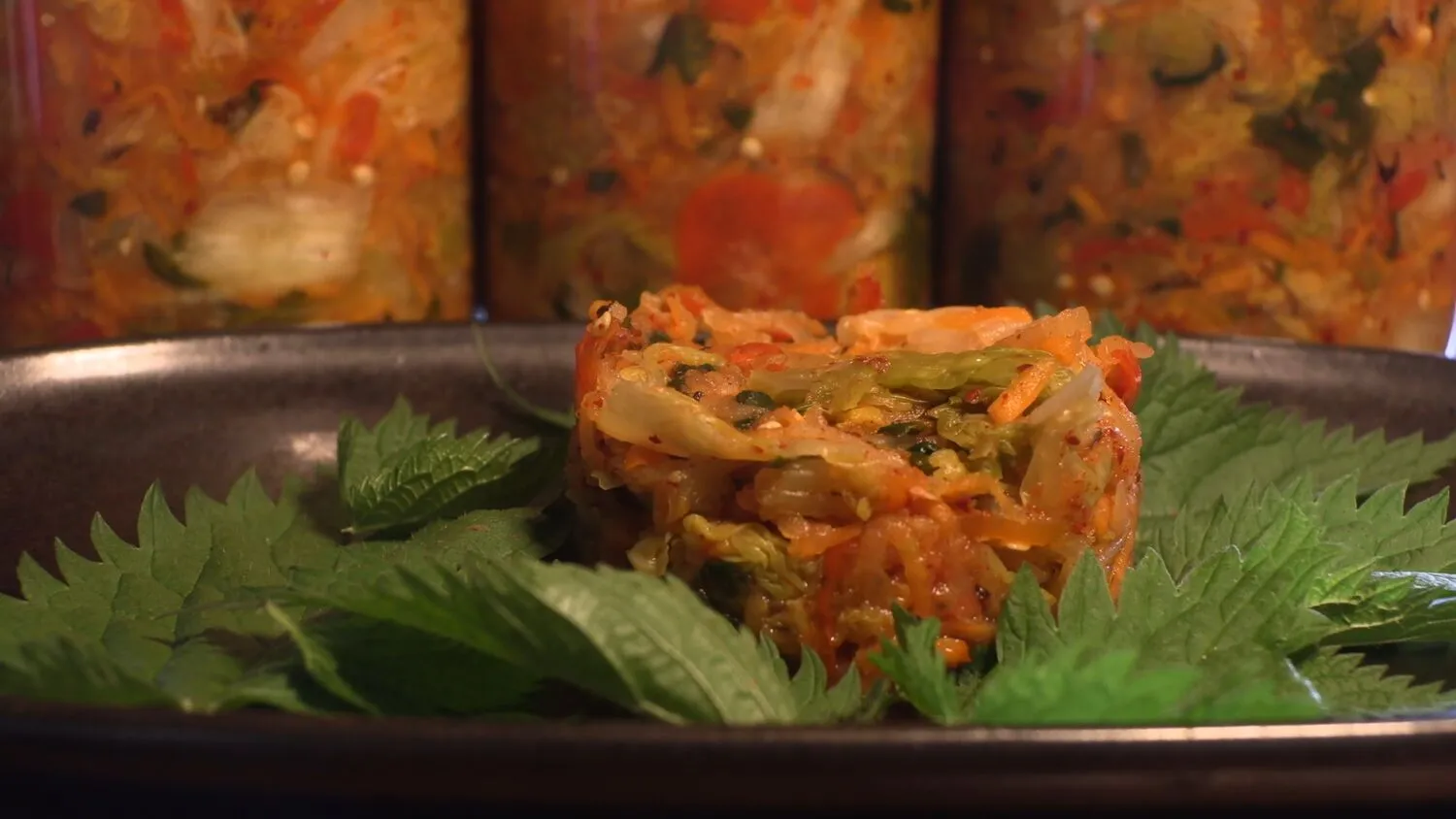
We make our lacto-fermented vegetables the way Korean households have for generations — but with our own touch. We call it Garden Kimchi, because instead of a fixed recipe, it’s built from whatever’s ready in the garden that week: sometimes cabbage and radish, sometimes chard, carrots, or whatever else the beds are giving us. That means every batch is genuinely a little different — a different mix of vegetables, a different balance of flavor — and that’s the point. It lets us escape the sameness of industrial production and enjoy something artisanal instead, made in small batches, always 100% organic, straight from our own soil.
Health Benefits
Lacto-fermentation is among the oldest food techniques still in use today. Naturally occurring lactic acid bacteria — chiefly various Lactobacillus species already living on fresh vegetables — feed on the natural sugars in the produce and convert them into lactic acid. This acidifies and preserves the vegetables while leaving behind a food carrying live bacterial cultures, the same broad category of organism often called probiotics.
The science is strongest on a few specific points: fermented vegetables can contain measurable, live lactic acid bacteria with probiotic characteristics, and a widely cited Stanford Medicine clinical trial found that a diet higher in fermented foods was linked to greater gut microbial diversity and lower inflammation markers over the course of the study. Beyond that, much of what’s traditionally said about fermented foods and digestion, immune support, or overall wellness rests more on generations of traditional use and ongoing research than on settled clinical proof. Because a large share of the body’s immune activity is tied to the gut lining, many traditions and researchers consider a diverse gut microbiome worth supporting — though the connection is still being studied, not conclusively mapped.
This information is for educational purposes only. Garden Kimchi and other fermented foods
are best enjoyed as a flavorful, traditional addition to a varied diet, not as a medical
treatment. This is not medical advice and does not replace the guidance of a qualified
healthcare professional.
A Tradition Across Cultures
Lacto-fermentation is a food-preservation method with deep roots across many cultures, developed long before refrigeration existed. Korean households have fermented vegetables into kimchi for centuries, originally as a way to survive harsh winters, while Central and Eastern European communities did much the same with cabbage, producing sauerkraut. Similar traditions appear in cuisines worldwide, each community adapting its own vegetables, spices, and techniques to local ingredients and climate — which is exactly the spirit behind our own Garden Kimchi, adapted to what grows here at 1,800m in Boquete’s cloud forest.
This article is © Wild on the Farm, Boquete Cloud Forest Lodge. All rights reserved — it may not be reproduced, republished, or redistributed without prior written permission. Read our full legal notice →