So What Is Permaculture, Exactly?
The word was born in Tasmania in the mid-1970s, out of the partnership between a naturalist and teacher, Bill Mollison, and one of his students, David Holmgren. Together they published Permaculture One in 1978. The term is a contraction of “permanent agriculture” — farming that can last — and it soon broadened into “permanent culture”: a way of designing not just a garden, but a whole place to live.
Because design is really what it’s about. Permaculture isn’t one more gardening technique, and it isn’t a certification label. It’s a design method inspired by how natural ecosystems work — a forest, a meadow, a forest edge — to lay out a productive space where every element does several jobs, and every need is met by several elements. Mollison set it out at length in his hefty Designers’ Manual in 1988; Holmgren distilled it in 2002 in Principles and Pathways Beyond Sustainability, around twelve principles that have become reference points for practitioners everywhere.
Three ethics to start with
Before any technique comes a compass. All of permaculture rests on three ethics — simple to state, demanding to live by:
- Earth care — soils, water, forests and everything that lives.
- People care — yourself, your family, your community.
- Fair share — set limits on consumption and redistribute the surplus.
David Holmgren’s twelve principles
They’re less rules than questions to ask yourself when you stand in front of a piece of land:
- Observe and interact
- Catch and store energy
- Obtain a yield
- Apply self-regulation and accept feedback
- Use and value renewable resources and services
- Produce no waste
- Design from patterns to details
- Integrate rather than segregate
- Use small and slow solutions
- Use and value diversity
- Use edges and value the marginal
- Creatively use and respond to change
In the garden, in practice
On the ground, these principles turn into habits that plenty of gardeners already practise without a name for them:
- Soil always covered — mulch, green manures, tightly planted beds — to feed soil life and shield it from both rain and sun.
- Companion planting: mix plant families, alternate roots and leaves, tuck flowers among the vegetables to draw in beneficial insects.
- Compost and homemade fertilisers: waste from one part of the system becomes food for another.
- Water management: terraces, swales, ponds — slow water down, sink it in, keep it.
- Zoning: what needs the most attention close to the house, what can look after itself further out.
- Integrated animals: chickens and sheep weed, fertilise, recycle — and produce.
- The food forest: layers of trees, shrubs, ground cover and climbers, just like a natural forest.
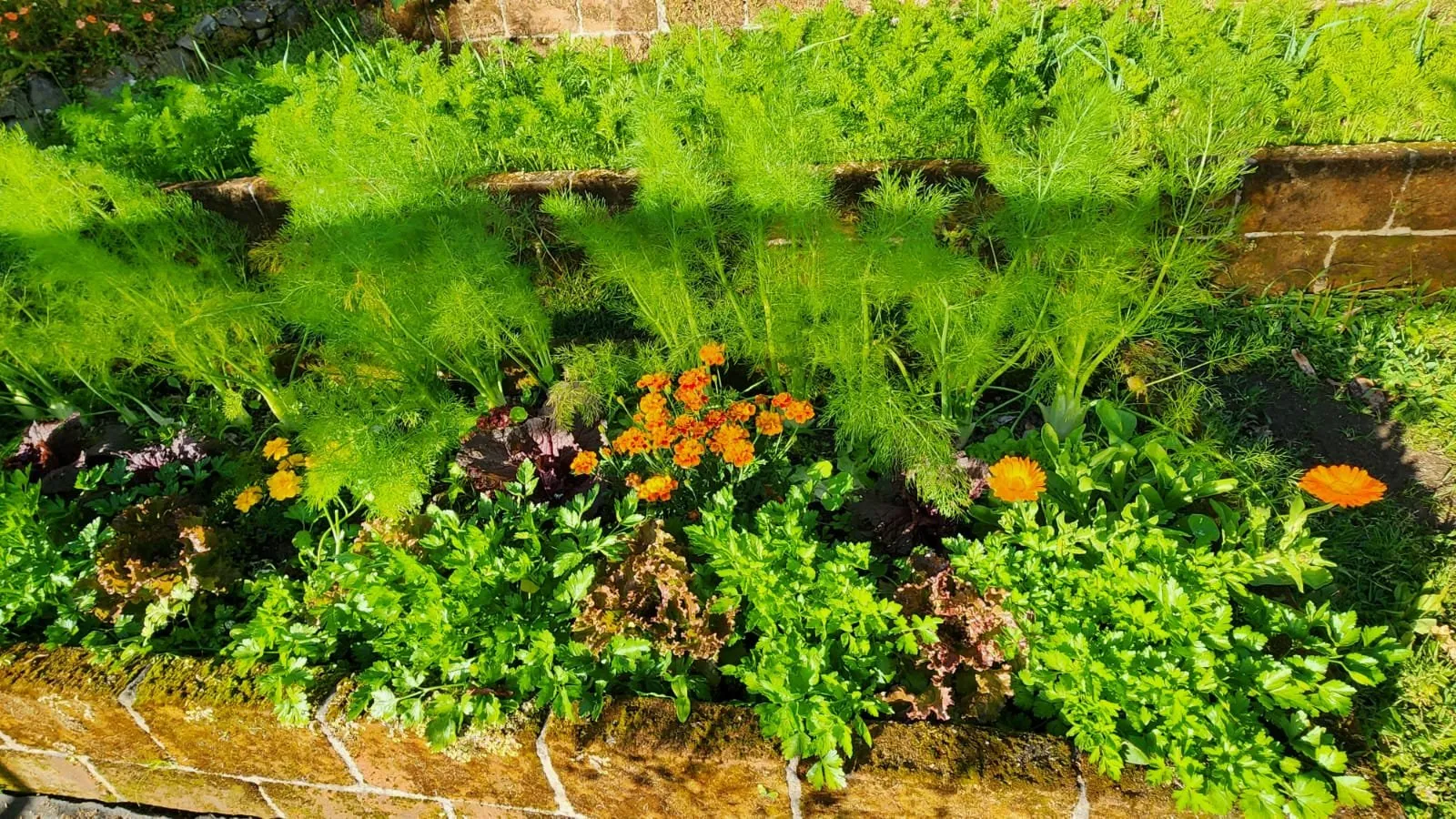
Photo: Wild on the Farm, vegetable garden.
A philosophy before a method
At heart, permaculture asks for a change of stance. Instead of “how do I force this land to produce?”, it asks “what does this place already know how to do, and how can I help it?” It favours patient observation over constant intervention, diversity over monoculture, resilience over the biggest possible yield in a single year. Mollison summed it up as working with nature rather than against it. Nothing revolutionary, really — and that’s exactly what takes us back to Paris.
Paris, 1844: When the Capital Grew Its Own Vegetables
The French word for market gardener, maraîcher, comes from marais — marsh: the low, damp ground (the Marais district still carries the name) where vegetables were grown at the city’s gates. In the mid-19th century, long before tractors and synthetic fertilisers, a belt of gardens supplied a large share of Paris’s fresh vegetables, all year round.
We know this in detail thanks to two market gardeners, J.-G. Moreau and J.-J. Daverne, who in 1845 published the Manuel pratique de la culture maraîchère de Paris (a practical manual of Parisian market gardening), which had won an 1844 competition held by the city’s agricultural society. They described their trade “as practised in Paris in 1844”, well aware that the railway and industry were about to change everything. Their figures are staggering: 1,378 hectares of market gardens around Paris, spread across 1,800 gardens averaging around 7,600 m² each, with 9,000 people at work — roughly five per garden.
Their secret? A remarkably coherent system. Paris then ran on tens of thousands of horses, and their manure was the market gardeners’ gold. Laid down as hotbeds, it fermented and gave off a gentle heat that made it possible to sow in the dead of winter. On top went a layer of compost, then glass frames and glass bell cloches — between them, the growers owned some 360,000 frames and more than two million cloches. Once spent, the manure became an exceptionally rich compost that went back into the soil. And the carts that took vegetables down to Les Halles came back loaded with manure and street sweepings from the city.
On those deep, fertile beds, crops were planted closely and interplanted: vegetables that grow at different speeds were sown together, so one could be harvested while the other took its place. According to accounts from the period, a single plot could yield six to eight harvests a year.
Permaculturists ahead of their time? Not quite — and it would be misleading to claim otherwise. The Parisian market gardeners were businesspeople, focused on the market and early produce, who worked relentlessly and relied on a great deal of glass and labour. But they applied, without the word, several principles Holmgren would formalise a century and a half later: produce no waste (city manure turned into heat, then compost), catch and store energy (fermentation under the frames), use small, intensive solutions, and integrate rather than segregate the city and its gardens.
Then it all unravelled. The city’s growth pushed the gardens ever further out, the railway brought in vegetables from distant regions, the car replaced the horse — and with it the manure — and chemical fertilisers made the old know-how look obsolete to modern agriculture. The rue des Maraîchers, in Paris’s 20th arrondissement, still keeps its memory.
But the ideas travelled. In 1909, the Englishman John Weathers published French Market-Gardening to bring these methods across the Channel. Closer to our time, the American grower Eliot Coleman drew heavily on them for his winter crops in Maine, and Quebec’s Jean-Martin Fortier built part of his bio-intensive “market gardener” method on them. Moreau and Daverne’s manual itself was reissued in French in 2016. The old Parisian know-how has come back through the front door.
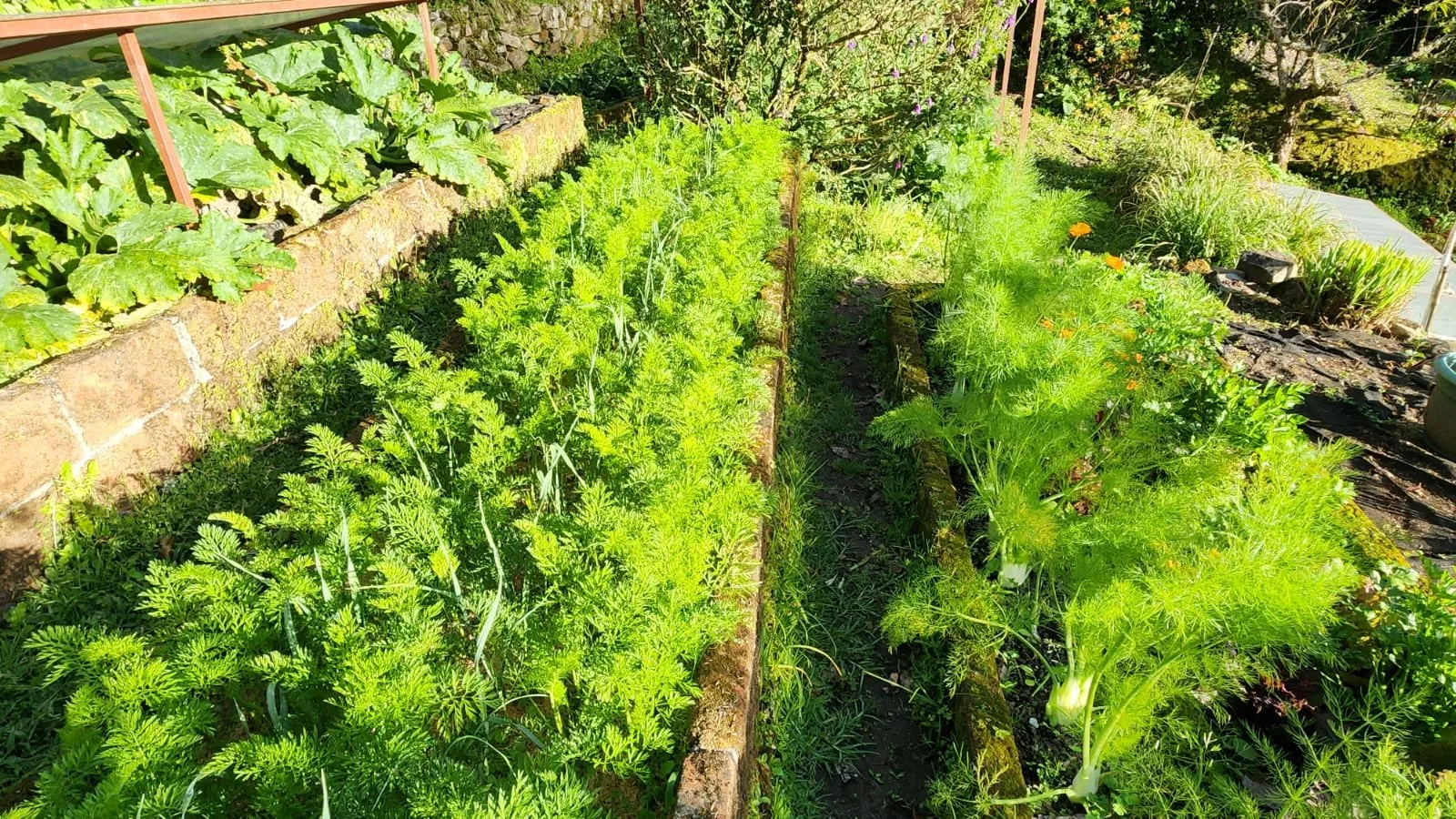
Photo: Wild on the Farm, vegetable garden.
A Tour of Panama: Permaculture in the Tropics
In the tropics, permaculture finds ground that is both ideal and demanding. Ideal because everything grows, all year long; demanding because heavy rains wash out bare soil, the sun bakes it, and monocultures quickly invite pests. The forest solved this long ago: keep the soil covered, layer the vegetation, recycle organic matter endlessly. No wonder Panama’s growers take their cue from it.
Long before the word existed, in fact, the isthmus’s Indigenous communities were already growing mixed gardens where fruit trees, root crops, medicinal plants and cacao live together under the canopy of tall trees — a form of agroforestry that modern permaculture has simply rediscovered.
Bocas del Toro, on the Caribbean side
The Bocas del Toro archipelago is probably home to more permaculture projects than anywhere else in the country. On Bastimentos Island, above the village of Old Bank, Up in the Hill has been growing cacao, coffee, fruit, coconuts and herbs using permaculture since 2003; its guided tours, run as Pure Tree Experience, follow cacao from the tree to the chocolate bar. On Isla Colón, a few kilometres from Bocas town, Finca Flora is developing a one-hectare seafront permaculture project focused on tropical fruit, vegetables, laying hens and hosting volunteers.
From pasture to food forest
Elsewhere in the country, more and more family farms are taking on a very Panamanian challenge: bringing old cattle pastures — often exhausted and compacted — back to life. Finca 588 is one of them, a family-run regenerative homestead turning former pasture into a food forest, with beekeeping, cheesemaking, ferments and hands-on workshops open to the public several times a year.
Chiriquí and the Boquete highlands
On the Pacific slope, the Chiriquí highlands offer an entirely different climate: altitude, cool air, the mists of the cloud forest and remarkably fertile volcanic soil. Around Boquete, the La Vida Orgánica association promotes permaculture, hydroponics and aquaponics, and a handful of small farms grow chemical-free for the Tuesday market. It’s here, at 1,800 metres, that our own story begins.
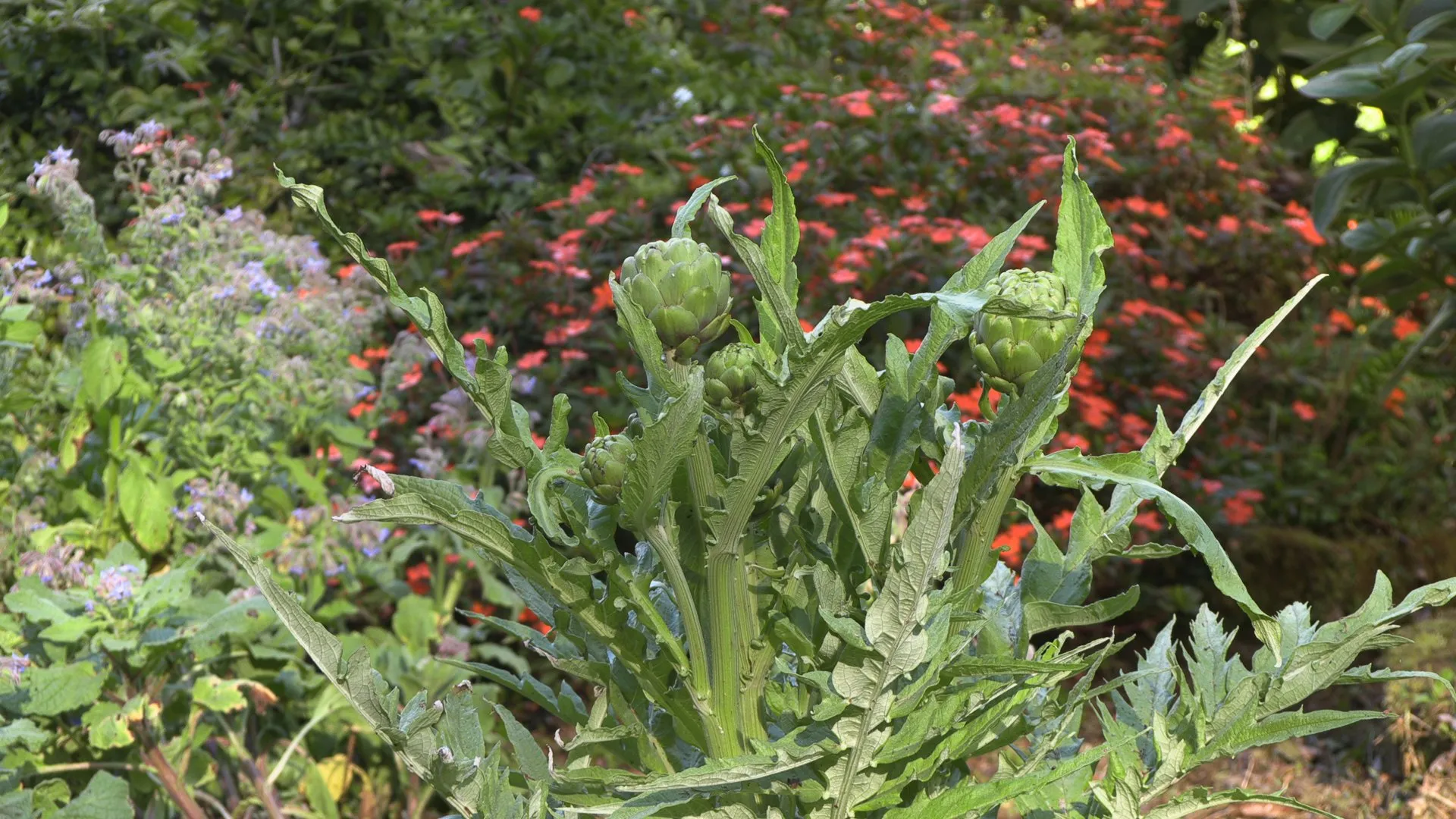
Photo: Wild on the Farm, vegetable garden.
Wild on the Farm: from Finca de la Amistad Verde to Today
Wild on the Farm was first called Finca de la Amistad Verde. Founded in 2008 in the hills above Boquete, on the edge of La Amistad International Park, it became in 2010 the first vegetable farm in Panama to be certified organic by Bio Latina. It supplied El Mercadito Biológico in Panama City and, together with farmer friends in the valley, introduced vegetable varieties that couldn’t yet be found in the country.
Eighteen years on, the farm has a new name, has turned toward macadamia, and welcomes guests in three cabins with living roofs. But the logic hasn’t changed: grow healthy food, without chemical inputs, by building on what the place already offers. Read the farm through Holmgren’s lens and you’ll find almost every principle at work:
- Catch and store energy: electricity comes from the sun, and water from a spring inside the national park.
- Produce no waste: sheep and chicken manure, garden and kitchen scraps all go to the compost, which goes back to feed the beds.
- Use renewable resources: no industrial fertilisers — instead, homemade fertilisers from fermented nettle, comfrey and tithonia, grown on site for the purpose.
- Integrate rather than segregate: the sheep keep the land in shape, the hens lay eggs and work the compost, the flowers protect the vegetables.
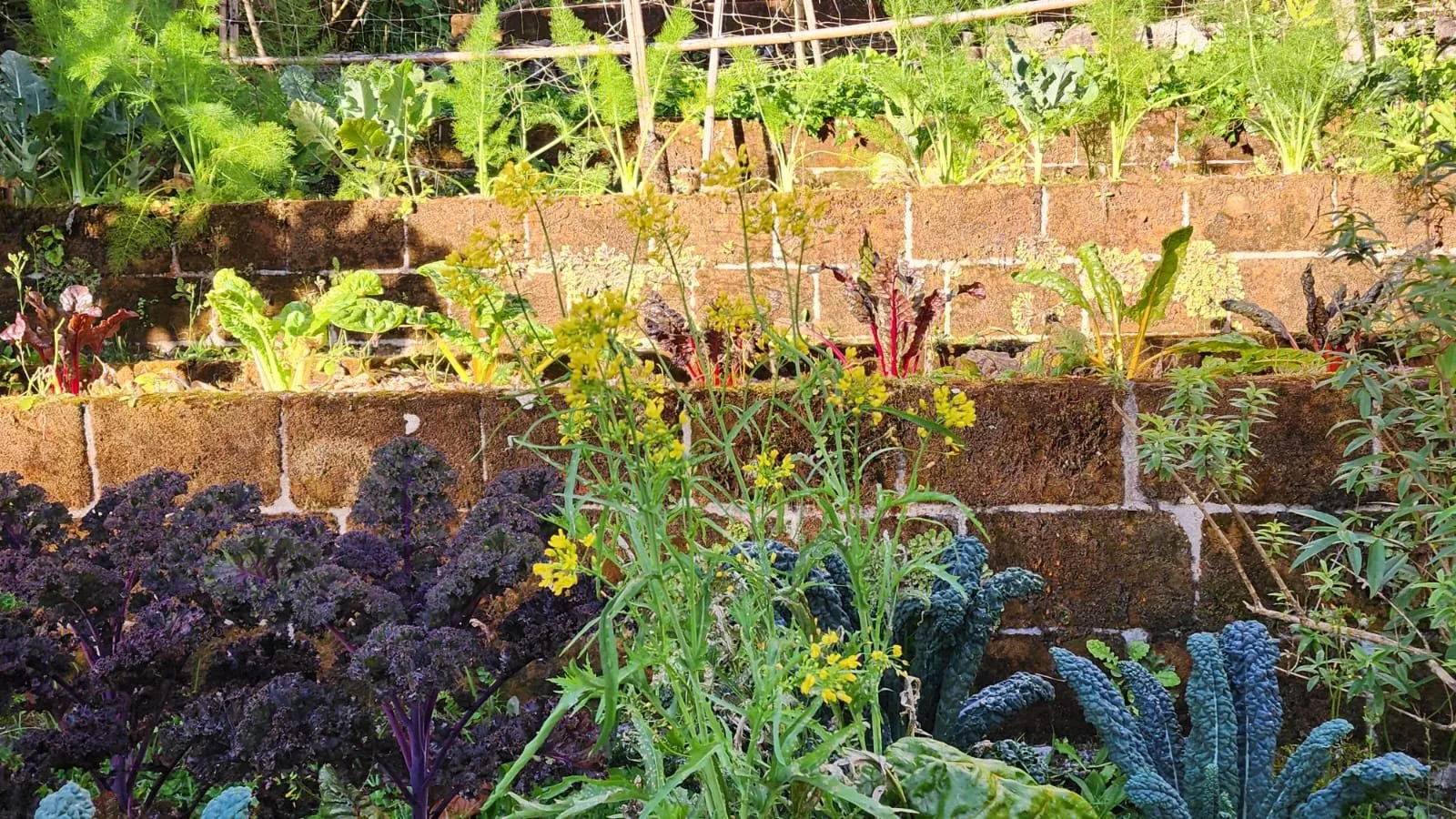
- Design from patterns to details: on a steep slope, block-lined terraces hold soil and water and organise the vegetable garden into rotations.
- Value diversity: vegetables, herbs, medicinal plants, flowers and macadamias, surrounded by untouched cloud forest.
- Value the edges: the boundary between garden and forest, home to birds, beneficial insects — and, with a little luck, the quetzal.
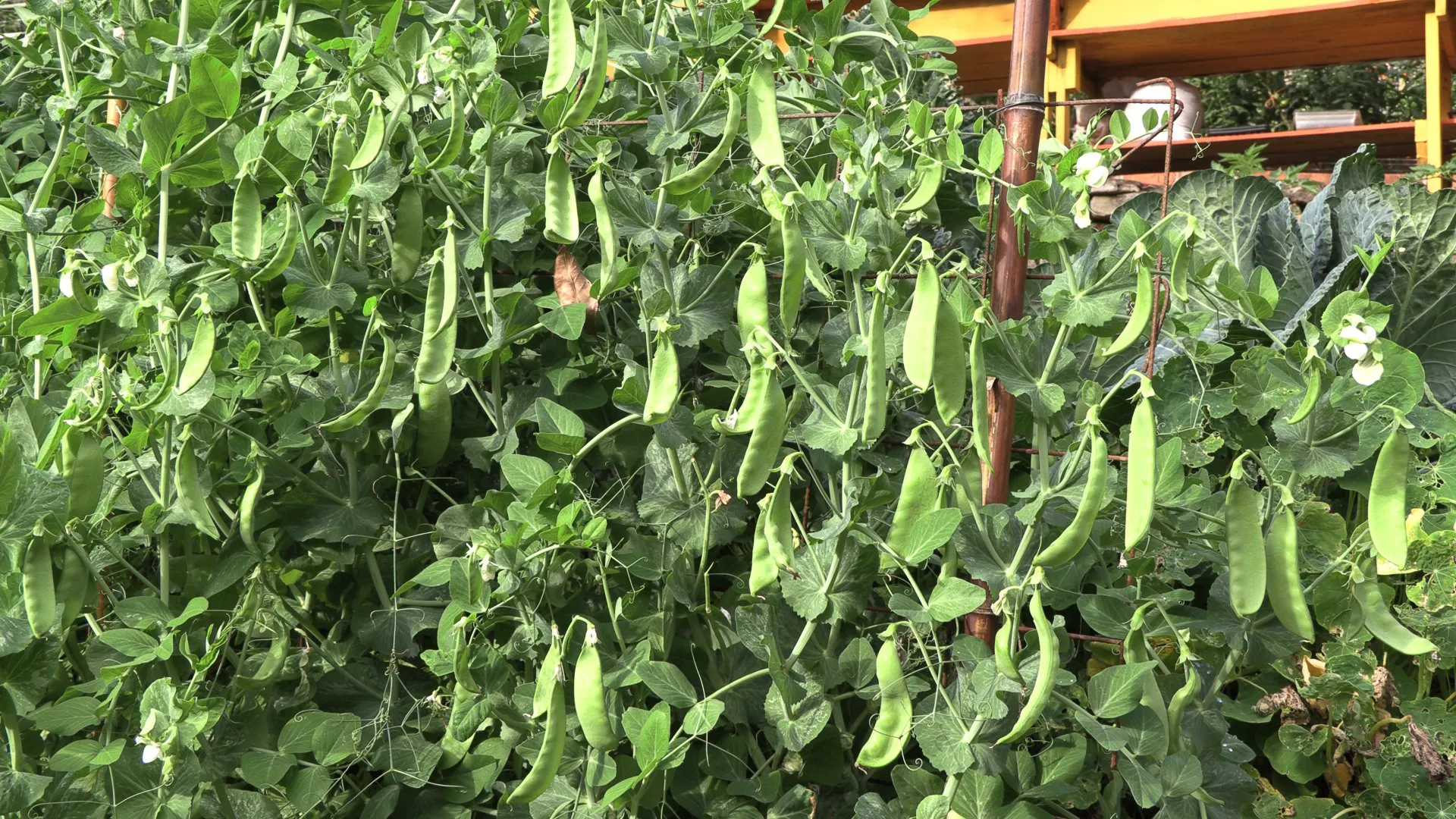
Photo: Wild on the Farm, vegetable garden.
What we serve at the table comes first from these terraces: vegetables picked that same morning, in season, grown in volcanic soil that we feed rather than mine. Nothing spectacular, really — the same idea as Paris in 1844, the same as Bocas del Toro today: a living place, well observed, that gives generously when it’s respected.
Guests at Wild on the Farm are welcome to wander the vegetable garden, see the terraces, the compost and the plant ferments, and taste what comes out of them every day. The best way to understand permaculture is still to watch it grow.
Explore our garden → Reserve your stay →
Main sources: David Holmgren, Permaculture: Principles and Pathways Beyond Sustainability (2002); J.-G. Moreau & J.-J. Daverne, Manuel pratique de la culture maraîchère de Paris (1845; reissued by Éditions du Linteau, 2016); Revue Sesame (INRAE), “Moreau & Daverne, influenceurs oubliés”; Vergers Urbains; New Society Publishers; official websites of Pure Tree Experience / Up in the Hill, Finca Flora and Finca 588.
This article is © Wild on the Farm, Boquete Cloud Forest Lodge. All rights reserved — it may not be reproduced, republished, or redistributed without prior written permission. Read our full legal notice →