Nutritional Properties & Benefits
The plum is the fruit of a tree in the rose family, cousin to the cherry, peach, apricot, and almond. More than 85% water and low in calories, it provides fiber, vitamin C, vitamin K, and potassium. Its red or purple skin is rich in anthocyanins, and its flesh in phenolic acids, both antioxidant compounds. It’s best known for its effect on digestion: it contains sorbitol, a natural sugar that is poorly absorbed and, together with the fiber, has a gentle laxative effect — an effect even more marked in the prune, the dried plum, where everything is concentrated. Two simple cautions: eating a lot at once can cause bloating and diarrhea, and the kernel inside the stone is not to be eaten, since it contains amygdalin, which releases cyanide when digested.
This information is for educational purposes only and reflects traditional and commonly documented uses of this plant. It is not medical advice and does not replace the guidance of a qualified healthcare professional. Always consult your doctor before using any plant medicinally, especially if pregnant, nursing, or taking medication.
How to Eat It
A ripe plum is eaten first of all as it is, picked when it gives slightly under the finger. Its juicy flesh, sweet at the center and tart near the skin, also makes it one of the best fruits for cooking: in a tart, a clafoutis, a crumble, roasted in the oven with a little honey, or as jam and compote, where the tartness of the skin adds depth. On the savory side, it becomes a chutney or a sweet-and-sour sauce for pork, duck, and cheese. Slightly firm plums are good for cooking; very ripe ones are for eating at once or blending into juice and sorbet. They keep for a few days in the cool, freeze well once pitted, and can be dried in a low oven to make your own prunes.
How to Grow It Organically
A plum tree needs little care, but one condition that’s hard to meet in the tropics: cold.
- The need for chill. To flower, temperate-climate fruit trees must accumulate a certain number of cool hours each year. Most plum trees need too many for the tropics; only those content with little cold succeed, and only at altitude.
- A grafted tree. Plant a young grafted tree, which reproduces the variety faithfully and fruits sooner than a seedling.
- Full sun, deep, well-drained soil. Plum trees dread standing water around the roots.
- A partner for pollination. Many plum trees crop better with another variety nearby; a few are self-fertile.
- Pruning that opens up the tree. Clear the center so that air and light get in: it’s the best prevention against disease in a humid climate.
- Thin the fruit. Removing some of the young plums when a branch carries too many gives bigger fruit and prevents breakage.
- Patience. The first real harvest comes three to four years after planting.
- Brown rot and birds. Brown rot of the fruit is the main trouble in the rain: pick up and remove affected fruit; a net protects the harvest from birds.
Plums in Our Garden
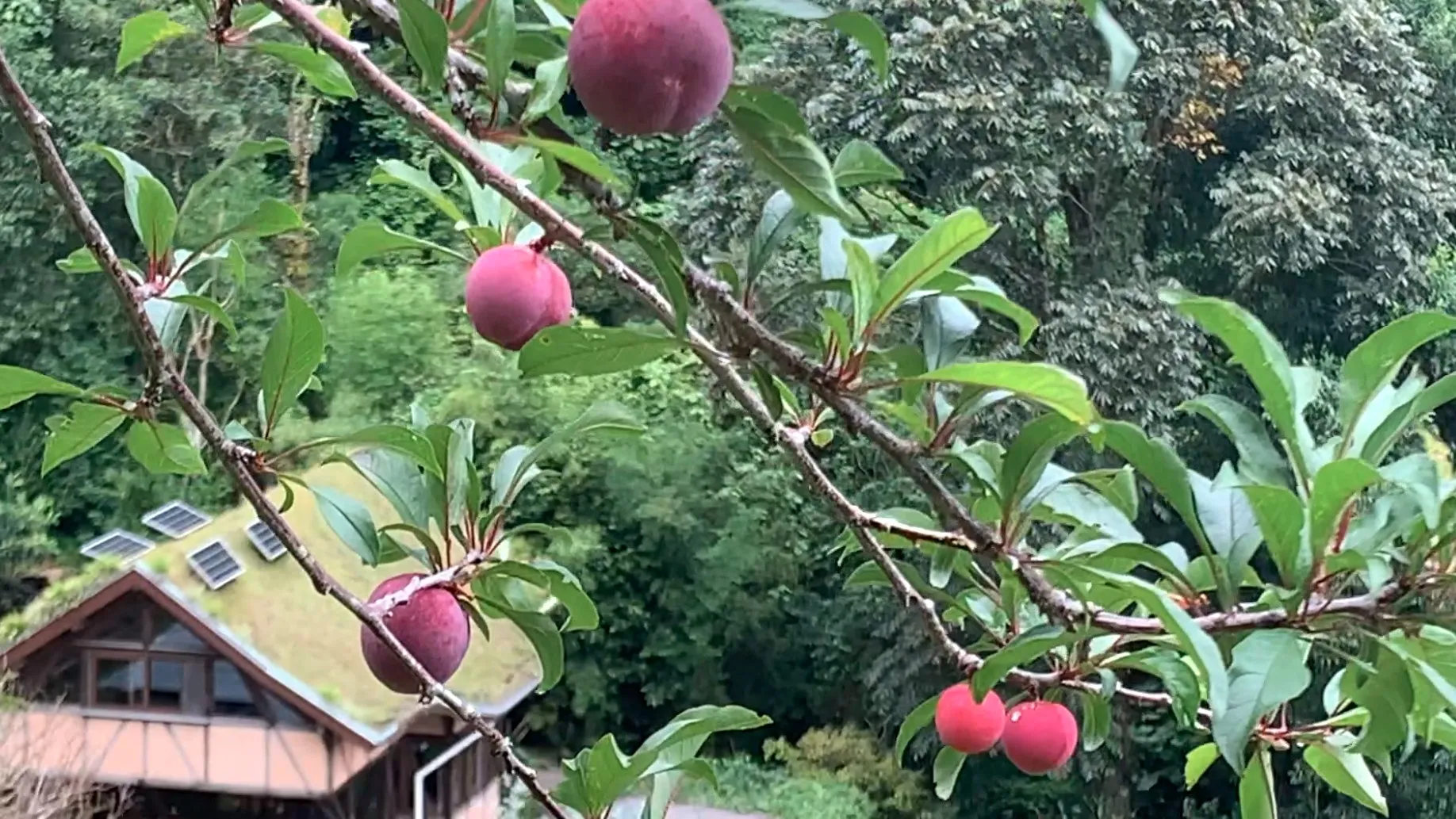
Growing plums in Panama is far from a given. At low altitude it’s simply impossible: the tree grows, but without cold it doesn’t flower. Altitude changes everything — at 1,800 meters, Horqueta’s nights are cool enough to give the tree part of the chill it demands, as in the other highlands of Chiriquí where temperate-climate fruit is also grown. We manage it: the plum tree in the photo, which we brought back from France and planted above the green-roofed lodges, carries purplish-red fruit covered in its fine bloom. Harvests remain modest and uneven from one year to the next, and the humidity of the cloud forest obliges us to prune to open up the tree and to watch for fruit rot. But every ripe plum, here, tastes of success.
Good Companions
- Comfrey. Planted at the foot, it draws up minerals from the subsoil and gives a rich mulch when cut.
- Clover and legumes. As groundcover, they add nitrogen without competing with the tree.
- Garlic and chives. At the foot of fruit trees, their scent is said to discourage certain pests and diseases.
- Nectar-rich flowers (borage, calendula, nasturtium). They bring in pollinators at flowering time.
Plants to Avoid
- Dense turf at the foot of a young tree. It competes for water and nutrients; a mulch or a chosen groundcover is better.
- Other stone-fruit trees too close together (peach, cherry). They share the same diseases; give them air.
- Tomatoes and potatoes under the tree. They can leave a disease in the soil, verticillium wilt, to which stone-fruit trees are susceptible.
Good to Know
- The white veil on the skin is natural. It’s the bloom, a fine wax the fruit produces to protect itself; it shows the fruit hasn’t been handled too much.
- A prune is a dried plum. Not every variety is suited to it: it takes very sweet fruit that dries without fermenting.
- France is a land of plums. Mirabelles from Lorraine, greengages, Alsatian quetsches, and Agen prunes: every region has its own.
- In Panama, ciruela often means another fruit. The traditional jocote or ciruela is a tropical fruit unrelated to the plum tree.
- Its cousins are famous. Cherry, peach, apricot, and almond all belong to the same genus, Prunus.
This article is © Wild on the Farm, Boquete Cloud Forest Lodge. All rights reserved — it may not be reproduced, republished, or redistributed without prior written permission. Read our full legal notice →