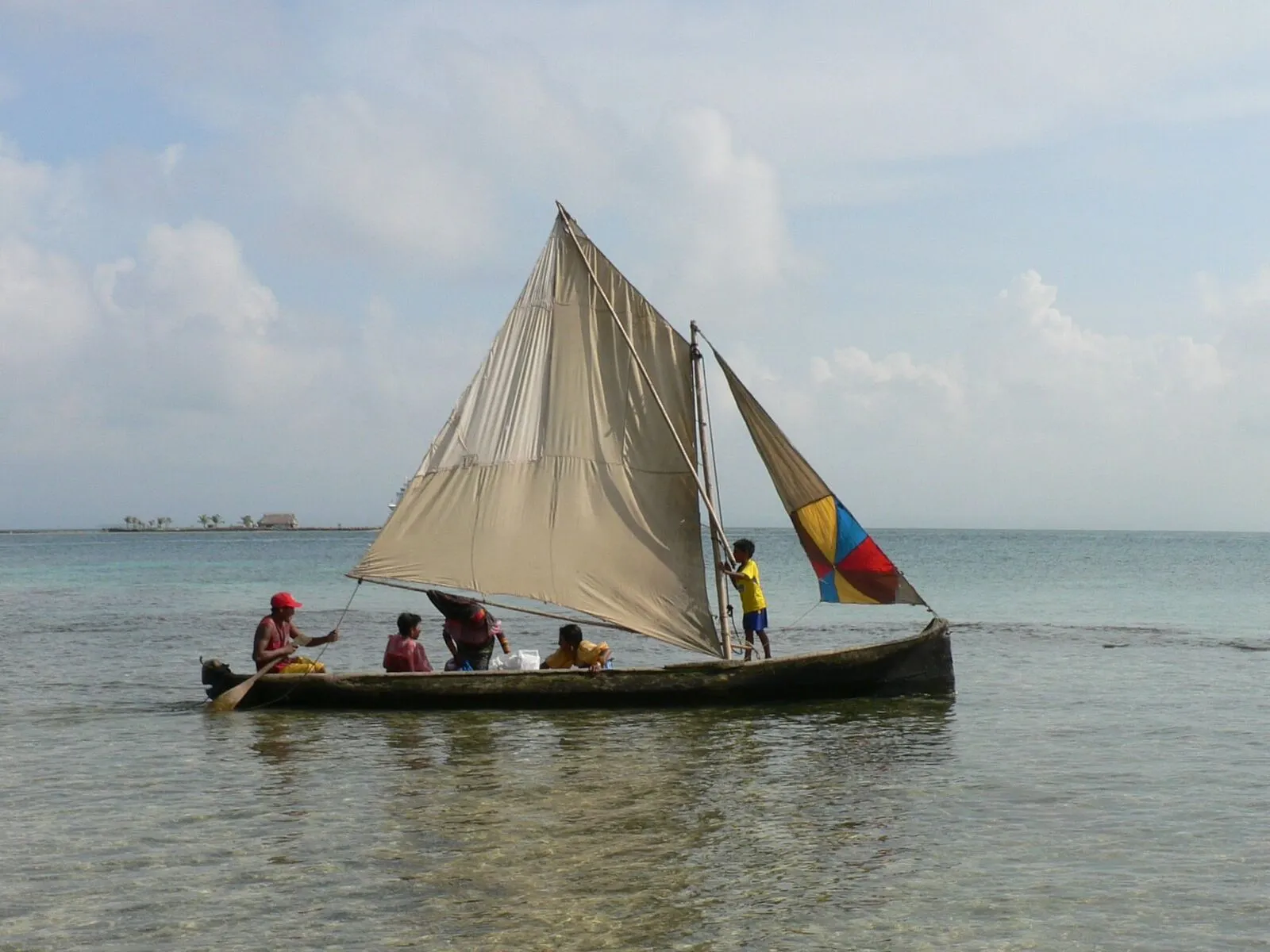
The Inhabitants
Officially named the Guna Yala comarca, this territory stretches along Panama’s Caribbean coast and includes about 370 paradise islands and islets. The Gunas form one of the most united and preserved Amerindian communities in Central America — originally from the continental forests, they migrated to the islands to escape diseases and invaders, adapting their lifestyle to the marine environment.
- A proud identity: the Gunas reject cultural assimilation. They consider themselves Gunas first and Panamanians second.
- The Dulegaya language: the Guna language remains the mother tongue, spoken daily and taught in the primary schools of the comarca.
- Matrilineality: society is based on a matrilineal system — the husband joins his wife’s family after marriage.
Ancestral Traditions
Guna culture is transmitted orally and expressed through strong visual symbols.
- The molas: these beautiful, colorful textile pieces with geometric designs are handmade using the reverse-appliqué technique. Women wear them proudly on their traditional blouses.
- Body ornaments: women adorn their arms and legs with tightly wrapped bead bracelets (wini) forming complex patterns, and draw a black line of jagua on their nose during ceremonies.
- The 1925 Guna Revolution: a founding event celebrated every year. The ancestors took up arms against forced assimilation attempts by the Panamanian government, securing their territorial autonomy.
A State Within A State
Thanks to the Panamanian law of 1953 and the Organic Charter of San Blas, the comarca operates with its own customary government. At the top sits the Guna General Congress (CGG) — the highest administrative authority, made up of delegates from the 49 communities of the comarca, meeting twice a year to vote on the laws governing the territory. Beneath it, a Political Congress and a Cultural Congress divide the work: the latter manages the protection of intangible heritage, spirituality, and sacred chants.
Each of the comarca’s roughly 51 communities and islands is led locally by a Saila (or cacique) — a spiritual and political leader. Local decisions are made by consensus under the roof of the Congreso, the large communal house of the island.
Tourism
In Guna Yala, large hotel complexes and foreign investors are strictly prohibited. The islands belong collectively to the Guna people, and the General Congress regulates the tourism industry through strict statutes:
- Infrastructure: only eco-cabins built with wood and thatch. No air conditioning or unnecessary luxury.
- Transportation: only indigenous 4x4 drivers and Guna motorized canoes (lanchas) are allowed to transport travelers.
- Local economy: comarca entry taxes (around $20–22 USD) and stay fees directly fund community infrastructure.
- Marine protection: underwater fishing with scuba tanks or commercial coral exploitation by outsiders faces heavy fines.
This model of community eco-tourism, formalized by their National Strategic Plan for Dule Tourism, serves today as a global example for safeguarding indigenous territories against mass tourism.
Two Very Different Wild Panamas
Guna Yala’s self-governed islands and Wild on the Farm, Boquete Cloud Forest Lodge’s organic farm at 1,800 metres couldn’t look more different on a map — yet both are Panama at its most authentic: places shaped by the people who’ve cared for them the longest, rather than by mass tourism. Many travelers pair a few island days in San Blas with the cool mountain air and silence of the highlands.
This article is © Wild on the Farm, Boquete Cloud Forest Lodge. All rights reserved — it may not be reproduced, republished, or redistributed without prior written permission. Read our full legal notice →