Medicinal & Therapeutic Properties
Thyme belongs to the same aromatic family as rosemary, and herbalists have long prized it as a “warming” plant, traditionally reached for at the very first chill or sniffle of a cold. It’s commonly used in herbal medicine as a soothing infusion for irritated bronchi, valued for its ability to help loosen and clear mucus while exercising a gentle antiseptic action — a combination that has made it a classic traditional remedy for coughs, bronchitis, and sore throats (often gargled). Traditional practice also draws on thyme for digestive comfort and to ease bloating. Diluted preparations have historically served as a field antiseptic for cleaning small wounds, and the herb is traditionally taken during convalescence as a general tonic. As with any concentrated preparation, it’s traditionally avoided in pregnancy and breastfeeding.
This information is for educational purposes only and reflects traditional and commonly documented uses of this plant. It is not medical advice and does not replace the guidance of a qualified healthcare professional. Always consult your doctor before using any plant medicinally, especially if pregnant, nursing, or taking medication.
Culinary Interest
Few herbs are as widely used as thyme. Its small, needle-like leaves carry an earthy, slightly peppery flavor with warm, faintly floral undertones that intensify rather than fade with cooking, making it one of the few fresh herbs equally at home added early or late in a dish. Thyme is a backbone of French and Mediterranean cooking — an essential part of herbes de Provence and the classic bouquet garni, alongside rosemary and bay. Whole sprigs are typically simmered in soups, stews, and stocks, then removed before serving, while stripped leaves season roasted vegetables, grilled meats, and marinades. It pairs naturally with garlic, lemon, and olive oil, and complements poultry, lamb, and white fish especially well.
Where to Find It in Panama
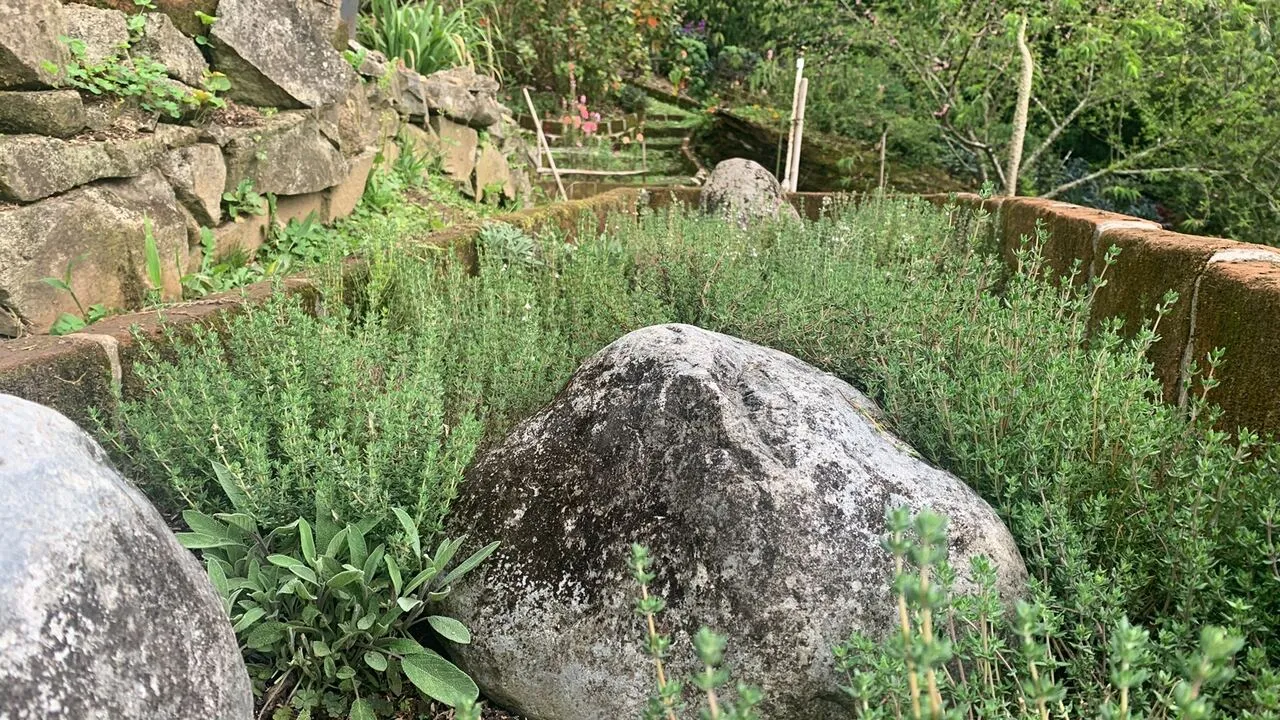
Like rosemary, thyme is a sun-loving Mediterranean shrub, and it’s genuinely hard to find growing anywhere in tropical Panama — most of the country is simply too hot and humid for a plant bred for dry Mediterranean aridity. It thrives at Wild on the Farm, Boquete Cloud Forest Lodge, thanks to our cloud forest’s unusually cool microclimate at 1,800m, which stays mild year-round — one of the few conditions in Panama able to support it at all. It’s grown right alongside our rosemary, in the stone herb bed pictured above.
This article is © Wild on the Farm, Boquete Cloud Forest Lodge. All rights reserved — it may not be reproduced, republished, or redistributed without prior written permission. Read our full legal notice →