Nutritional Properties & Benefits
The leek (Allium ampeloprasum, Leek group — sometimes still referred to by its old name Allium porrum) is more than 80% water, which doesn’t stop its slender leaves and white shaft from packing real nutritional density. It’s an excellent source of vitamin K, essential for blood clotting and bone health, and of manganese, while also providing worthwhile amounts of vitamin B6, folate, and vitamin C. Like other alliums, it contains sulfur compounds — less concentrated than in garlic or onion, but definitely present — as well as fructans, a prebiotic fiber that feeds the gut flora. Its French name, “poireau,” descends from the Latin porrum via the Old French porel; its botanical name now places it in the same species as elephant garlic, which often surprises people, so different do the two vegetables look. The white shaft, produced by keeping light from the base of the stem as it grows, is the most tender and prized part, while the more fibrous green is better suited to flavoring stocks and sauce bases.
This information is for educational purposes only and reflects traditional and commonly documented uses of this plant. It is not medical advice and does not replace the guidance of a qualified healthcare professional. Always consult your doctor before using any plant medicinally, especially if pregnant, nursing, or taking medication.
How to Eat It
The leek is one of the most versatile vegetables in the kitchen, able to play a supporting role as well as the lead. Slowly melted in butter, it becomes the silky base of classic French fondue de poireaux or leek-and-bacon quiche; blended with potato, it makes vichyssoise, just as good hot as cold. Braised whole and dressed with vinaigrette, it’s served as a starter in the style of traditional French “poireaux vinaigrette.” The tougher green part, often discarded, deserves to be kept to flavor stocks, soups, and bouquets garnis, where its firm texture hardly matters. Raw and finely sliced, it brings a sharp, fresh note to composed salads — a less common use that highlights its natural crunch.
How to Grow It Organically
The leek asks for patience more than skill: it’s a long crop, but not fussy once established, and especially rewarding for those who know how to wait.
- Early sowing and transplanting into a trench. The seeds germinate slowly; they’re usually sown in a nursery bed or seed tray, then the young plants are transplanted, once they reach the thickness of a pencil, into a shallow trench that is gradually filled in — this progressive hilling is what lengthens and blanches the shaft.
- A long cycle of 90 to 150 days depending on the variety. Unlike lettuce or Chinese cabbage, the leek takes its time; it’s an investment of several months, but one that needs little attention between hilling stages.
- Rich soil and constant watering. The leek is a heavy feeder that likes deep soil, well amended with compost, and steady moisture — dry spells slow its growth and toughen its fibers.
- Good cold tolerance and a staggered harvest. The leek tolerates frost far better than most garden vegetables and can stay in the ground, ready to be harvested as needed, rather than all at once.
- Leek moth and onion fly are the main pests. Insect netting laid early remains the best organic protection; crop rotation also limits the buildup of these pests from one year to the next.
Leeks in Our Garden
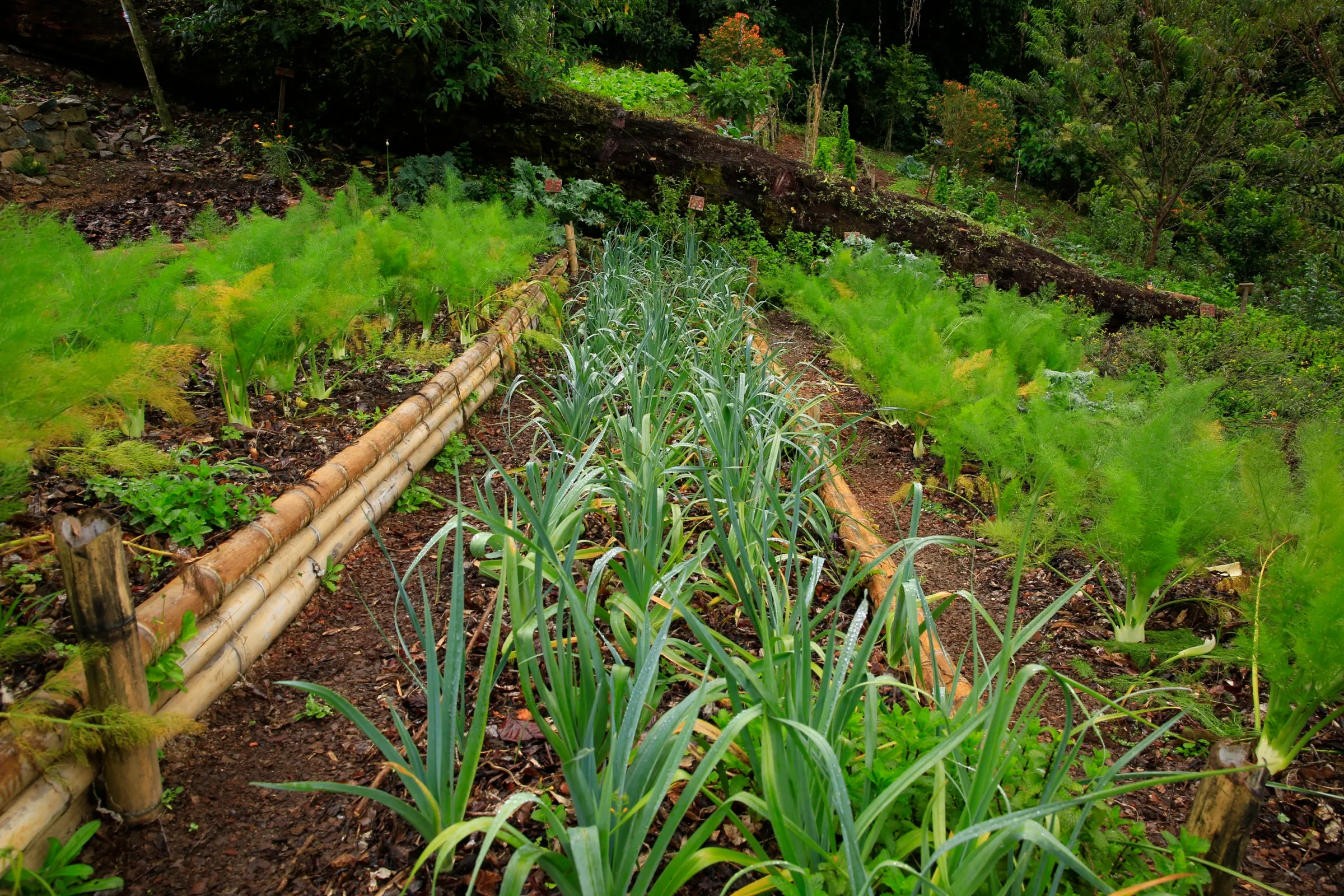
The cool, stable climate of the cloud forest around Horqueta suits remarkably well a vegetable that, elsewhere in the tropics, would suffer from prolonged heat and fast-drying soils. Here the leek benefits from volcanic soils rich in organic matter — exactly the kind of deep, fertile ground it needs to develop a fleshy shaft — and the altitude gives it moderate temperatures almost all year round, sparing it the stress that, elsewhere, would encourage premature bolting. It’s a crop you can safely leave in the ground for several weeks longer than planned — a real advantage at altitude, where climatic extremes are rare.
Good Companions
- Carrot. The best-known mutual pairing in the vegetable garden: the smell of leek confuses the carrot fly, while the smell of carrot in turn confuses the leek moth — a fair exchange between two crops that don’t compete for space or nutrients.
- Celery. A good traditional neighbor with no notable competition, both enjoying rich, moist soil.
- Strawberries. Discreet and compact, the leek grows happily along the edge of a strawberry bed without shading it.
- Cabbages and other brassicas. A common pairing in the vegetable garden, the leek providing a scent break that can limit certain cabbage-specific pests.
- Chamomile. Widely used as a general companion plant in organic gardens, it’s thought to attract beneficial insects useful to the whole bed.
Plants to Avoid
- Legumes — beans and peas. This pairing is traditionally discouraged: alliums like leek are thought to contain compounds that interfere with the nitrogen-fixing bacteria associated with legume roots, although this interaction is documented mainly by practice rather than rigorous studies.
- Other alliums planted too close (onion, garlic). Not because of chemical incompatibility, but because they share the same pests (onion fly, leek moth) and the same nutritional needs, which helps problems spread from one plant to the next.
Good to Know
- The leek is the national emblem of Wales. Legend has it that Saint David asked his soldiers to wear a leek on their helmets during a battle against the Saxons, to tell themselves apart from the enemy in the middle of a field of… leeks.
- The Roman emperor Nero ate them every day, so much so that he was nicknamed Porrophagus — “the leek eater” — believing the vegetable improved the quality of his voice.
- It has been grown since ancient Egypt, where its place in the diet is attested as early as the second millennium BC, as it is in Mesopotamia in the same period.
- Its botanical classification groups together vegetables that look very different. The leek and elephant garlic both belong to the species Allium ampeloprasum — a reminder that the visual diversity of vegetables doesn’t always reflect how closely related they are genetically.
This article is © Wild on the Farm, Boquete Cloud Forest Lodge. All rights reserved — it may not be reproduced, republished, or redistributed without prior written permission. Read our full legal notice →