Nutritional Properties & Benefits
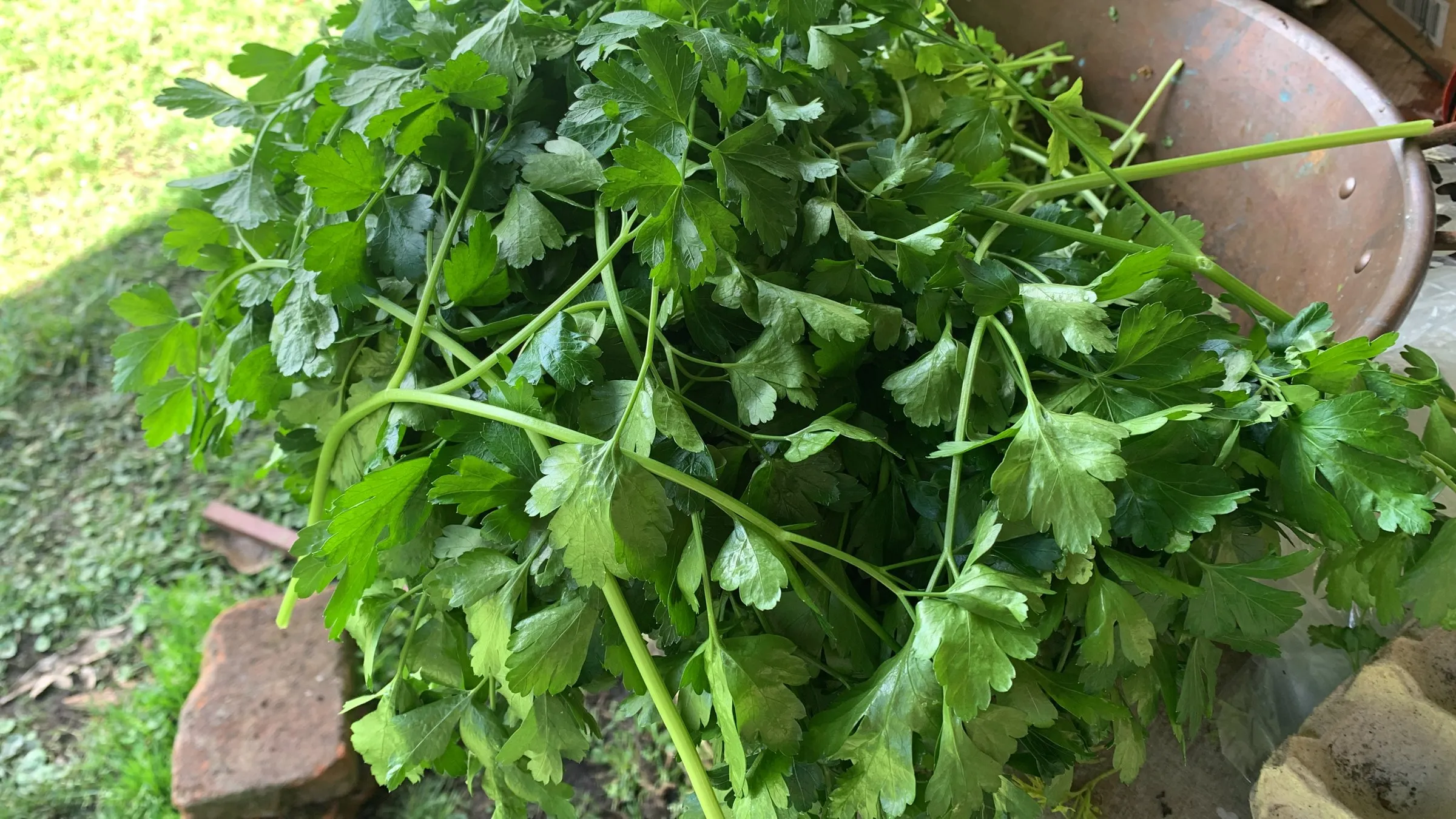
Parsley (Petroselinum crispum) is surprisingly rich for a plant usually eaten in small amounts: it’s one of the best plant sources of vitamin K, essential for blood clotting and bone health, with levels far higher than those of many leafy greens that are famous for it. It also provides a notable dose of vitamin C and iron, as well as antioxidant flavonoids such as apigenin, studied for its anti-inflammatory properties. Its botanical name comes from the Greek petros (stone) and selinon (celery, to which it’s related within the Apiaceae family) — literally “rock celery,” a reference to its original habitat, the rocky, limestone ground around the Mediterranean. Parsley also contains a small amount of essential oil rich in apiole, a compound traditionally credited with diuretic properties, to be consumed in moderation in concentrated form. It’s a biennial: it builds up its reserves in foliage the first year, then goes to seed the second — a detail that explains a lot about how it grows.
This information is for educational purposes only and reflects traditional and commonly documented uses of this plant. It is not medical advice and does not replace the guidance of a qualified healthcare professional. Always consult your doctor before using any plant medicinally, especially if pregnant, nursing, or taking medication.
How to Eat It
Flat-leaf parsley (known as “Italian”), more fragrant than curly parsley, is the base of persillade and gremolata, those mixtures of garlic, lemon zest, and chopped parsley that instantly lift grilled meat or fish. It’s also a mainstay of the French bouquet garni and fines herbes, and of Lebanese tabbouleh, where it’s not just a seasoning but the main ingredient, in generous quantities. In Latin America, it goes into Argentine chimichurri, that bright garlic-and-vinegar sauce served with grilled meat — not so far from how it can be used here on the farm, with local grilled meats. Less well known: parsley fried in hot oil for a few seconds becomes crisp and loses its bitterness, a surprising garnish for fish. The stems, often thrown away, are actually just as fragrant as the leaves and are worth keeping for stock.
How to Grow It Organically
Parsley has a well-deserved reputation for being fussy at just one stage: germination. Once it’s up, it’s a sturdy, undemanding plant.
- Notoriously slow, patchy germination. It often takes three to four weeks, because of natural compounds in the seed coat that inhibit germination — hence the old European saying that parsley seed “goes to the devil seven times” before it comes up. Soaking for 24 hours before sowing speeds things up considerably.
- A taproot: sowing in place is recommended. Like the carrot, to which it’s related, parsley transplants only moderately well once its root has developed; direct sowing, or very early transplanting from a pot, gives better results.
- A cool-climate plant, sensitive to excessive heat. Under prolonged heat, parsley turns bitter and tries to go to seed — behavior very similar to lettuce.
- Harvest by the leaf, never all at once. Pick the older outer stems, leaving the heart to produce new shoots — a method that allows continuous harvesting for several months.
- Few serious pests, apart from swallowtail butterfly caterpillars, which are especially fond of its foliage; in organic systems, this is often seen as an acceptable trade-off rather than a problem, given how beneficial the butterfly is to the garden.
- A second year to plan for. If parsley isn’t fully harvested, it regrows the following spring, flowers, then sets seed — useful if you want to save your own seed, but the foliage then becomes fibrous and unappetizing.
Parsley in Our Garden
The cool, stable climate of the Horqueta cloud forest is probably one of the most favorable environments you can offer parsley in the tropics: without the heat peaks that make it bolt prematurely in the lowlands, it can grow here almost all year round, producing dense, tender foliage for months rather than weeks. The region’s volcanic soils, rich in organic matter, suit its modest fertility needs well, and its deep roots make it a good candidate for the edges of beds, where it enjoys cool, loose soil without competing with neighboring shallow-rooted crops.
Good Companions
- Tomato. A classic, well-documented pairing: parsley attracts beneficial insects (notably hoverflies, whose larvae devour aphids and thrips) that protect tomatoes without competing with them for resources in any significant way.
- Asparagus. One of the companion plantings most often cited by organic gardeners; parsley seems to benefit asparagus by attracting useful insects and repelling certain harmful beetles.
- Alliums — chives, garlic, onion. Good general neighbors with no marked competition, and a smell that makes life harder for certain pests looking for their host plants by scent.
- Carrot. Cousins from the same botanical family (Apiaceae), they share similar soil needs and traditionally get along well in a mixed bed.
- Sweet pepper and chili. Good neighbors at the back of the bed, with no significant competition for light or nutrients.
Plants to Avoid
- Lettuce, which some gardeners avoid planting right next to parsley because of empirically reported competition — scientific evidence for this incompatibility remains limited, as is typical of gardening tradition on this kind of pairing.
- Mint, less because of chemical incompatibility than because of its invasive nature: it quickly takes over the available space and moisture, at the expense of slower-growing parsley.
- Very thirsty, large crops, which dry out and warm the soil around them — a stress that parsley, with its deep but fine roots, copes with poorly over time.
Good to Know
- The ancient Greeks didn’t eat it. They mainly used parsley to crown the winners of the Isthmian Games and to decorate tombs — a plant associated with mourning in mythology (linked to the death of the young Archemorus) rather than with the table. It was the Romans who first popularized its culinary use.
- There are two main types, with quite distinct uses: curly parsley, more decorative and long used as a mere garnish, and flat-leaf (or “Italian”) parsley, much more fragrant and favored in cooking.
- It’s a cousin of the carrot, celery, fennel, and dill. All belong to the Apiaceae family, recognizable by their umbrella-shaped flower clusters — a kinship that explains why the swallowtail, that large yellow-and-black butterfly, readily lays its eggs on its foliage.
- Its slow germination inspired a whole body of European folklore. Beyond the saying about the devil, it was also said that only a woman who “wears the trousers” in her marriage could successfully get parsley to sprout — a belief that says more about the societies that invented it than about the plant itself.
This article is © Wild on the Farm, Boquete Cloud Forest Lodge. All rights reserved — it may not be reproduced, republished, or redistributed without prior written permission. Read our full legal notice →