Nutritional Properties & Benefits
Swiss chard (Beta vulgaris subsp. vulgaris, var. cicla) is a direct cousin of beetroot, grown for its leaves and stems rather than its root. Its dark green leaves are among the most nutrient-dense leafy greens: very rich in vitamin K1 (essential for blood clotting and bone health), in vitamin A in the form of beta-carotene, and in vitamin C. It also provides magnesium, potassium, and iron, as well as specific antioxidants such as betalains — the same pigments that color beetroot, present here in smaller amounts but with comparable antioxidant interest. Like spinach, it also contains oxalates, something to keep in mind for people prone to kidney stones, who sometimes prefer to eat it cooked rather than raw.
This information is for educational purposes only and reflects traditional and commonly documented uses of this plant. It is not medical advice and does not replace the guidance of a qualified healthcare professional. Always consult your doctor before using any plant medicinally, especially if pregnant, nursing, or taking medication.
How to Eat It
Chard is cooked in two stages, almost like two separate vegetables. The stems, fleshy and crunchy, are prepared like asparagus or celery: blanched then sautéed, baked au gratin with a béchamel, or pan-fried with garlic and olive oil. The leaves, thinner, wilt quickly in a pan or steamer, a bit like spinach but with an earthier, slightly stronger flavor — excellent in gratins and quiches, or simply sautéed with garlic and a squeeze of lemon. Chard also works very well in soups, curries, and stuffings, and its young shoots can be eaten raw in salads. Nothing goes to waste: the stems cook a little longer than the leaves, so the leaves go in at the end to keep them from falling apart.
How to Grow It Organically
Chard is one of the easiest and most generous leafy greens in the organic garden — few serious diseases, remarkable tolerance of both heat and light cold, and an ability to regrow after every cut that makes it a sure bet.
- Direct sowing or transplanting — both work. Unlike carrots, chard has no fragile taproot and transplants very well as young plants. Each “seed” is actually a cluster containing several seeds, which is why several seedlings often come up in the same spot — they need to be separated or thinned early.
- Rich, well-amended soil. Unlike carrots, chard actually likes soil generously enriched with mature compost or well-rotted manure: it’s a heavy nitrogen user, which it needs to produce abundant foliage.
- Spacing of 30 to 40 cm. Plants grow larger over time; generous spacing from the start avoids having to thin too harshly later.
- Continuous harvest, leaf by leaf. You never harvest the whole plant: take the largest outer leaves at the base, leaving the heart to keep producing. A single plant can provide harvests for several months, even a whole season.
- Few serious pests, apart from slugs on young plants and leaf miners, whose larvae leave characteristic pale tunnels — simply remove the affected leaves.
- A biennial treated as an annual. Like beetroot, chard goes to seed in its second year; it’s almost always grown as an annual, harvesting only the foliage before it flowers.
Swiss Chard in Our Garden
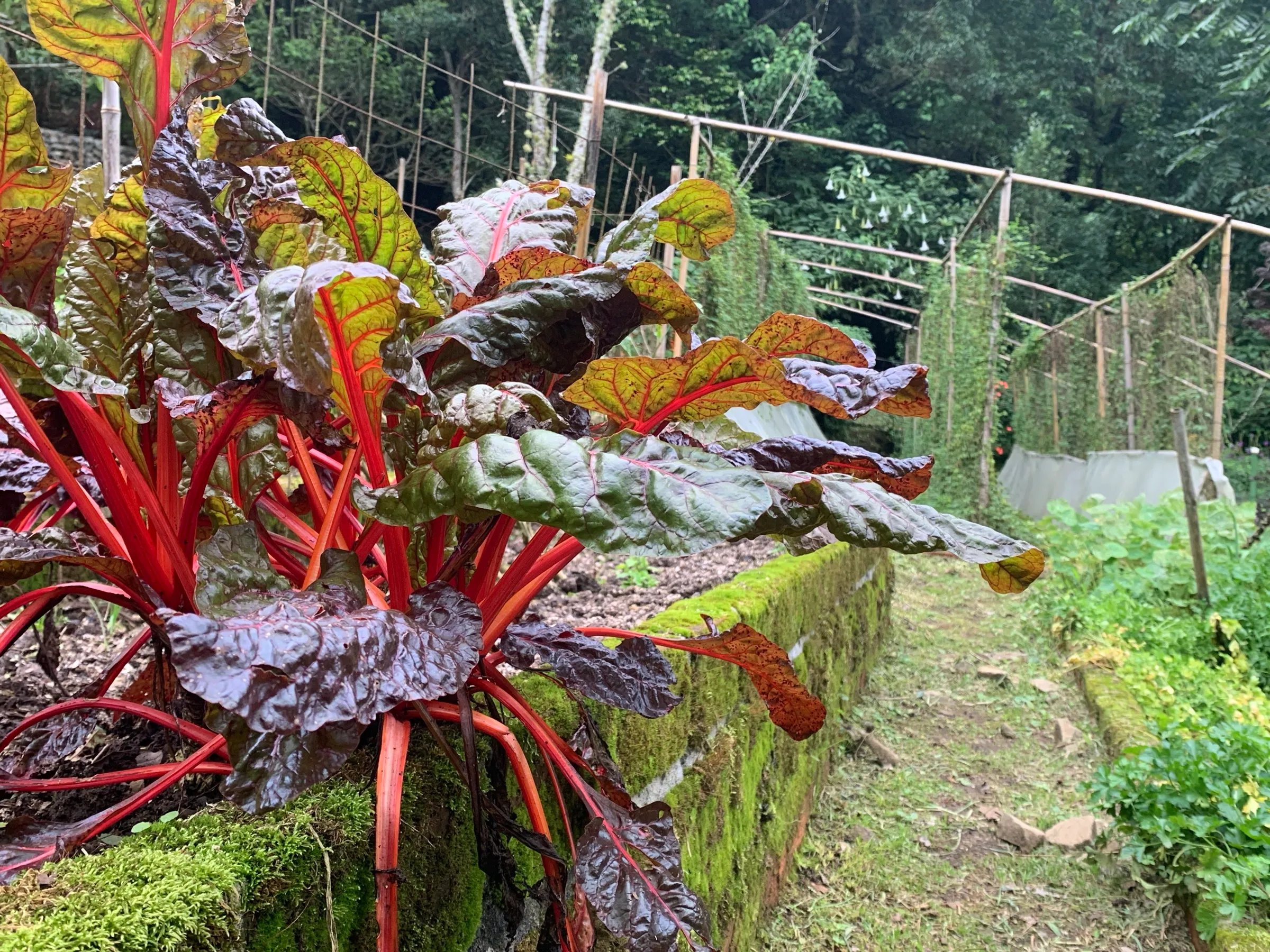
It’s one of the most forgiving vegetables in a mountain garden: it tolerates the cool nights at altitude as well as warmer spells, and its remarkable resistance to early bolting makes it a sure bet even when temperatures vary a lot from one week to the next. On rich volcanic soils it grows with particular vigor — the stems thicken beautifully and the colors (white, yellow, red, or pink depending on the variety) are often more intense at altitude, where the light is strong and the nights cool. It’s also one of the most dependable vegetables in the harvest basket, almost all year round, leaf after leaf.
Good Companions
- Alliums — onion, garlic, leek, chives. As with many leafy greens, their strong smell helps confuse pests that find their host by scent.
- Legumes — beans, peas. Their ability to fix atmospheric nitrogen directly benefits chard, a heavy nitrogen user for its foliage.
- Brassicas — cabbage, cauliflower, radish. Good general neighbors, with no marked competition for resources and no shared specific pests.
- Mint and rosemary. Useful as borders for their repellent effect on certain insects, without hindering the growth of nearby chard.
Plants to Avoid
- Beetroot and spinach. Both from the same botanical family (Amaranthaceae, Chenopodiaceae subfamily), they share the same pests and diseases — notably downy mildew and Cercospora leaf spot — so keep them apart to limit spread.
- Fennel. As with many vegetables, fennel’s allelopathic effect, which inhibits the growth of many neighboring plants, applies to chard too.
- Cucurbits planted too close. Without any outright incompatibility, squash and cucumbers have very spreading root systems that can rob chard of space and resources if planted too near.
Good to Know
- It’s the same species as beetroot. Chard and garden beetroot are two varieties of the same botanical species, Beta vulgaris — one selected over the centuries for its foliage, the other for its root. That’s why they share the same pests and shouldn’t be grown side by side.
- It goes by several names depending on the region. Chard, Swiss chard, silverbeet, leaf beet, spinach beet — several regional names refer to the same plant, which sometimes confuses beginner gardeners.
- Its bright colors are as much an ornamental choice as a culinary one. “Bright Lights” or “Rainbow” varieties, with red, yellow, or pink stems, are grown as much for the beauty of their foliage in the garden as for their flavor, which barely differs from one color to another.
- It has very ancient Mediterranean origins. Wild chard still grows on Mediterranean coasts today, and its cultivation dates back to antiquity — far older than that of fleshy-rooted beetroot, a later selection of the same plant.
This article is © Wild on the Farm, Boquete Cloud Forest Lodge. All rights reserved — it may not be reproduced, republished, or redistributed without prior written permission. Read our full legal notice →