Nutritional Properties & Benefits
Zucchini (Cucurbita pepo) is a fruit-vegetable that’s more than 94% water, which makes it especially light and hydrating — but it’s far from nutritionally empty: it provides a good amount of potassium, useful for fluid balance and muscle function, as well as vitamin C and folate (vitamin B9), concentrated mostly just under the skin — a good reason not to peel it. Its flesh also contains manganese and small amounts of lutein and zeaxanthin, two carotenoids associated with eye health, more abundant in dark-skinned varieties. Its botanical name, Cucurbita, shared by all squashes, comes from the classical Latin for the gourd; the French word “courgette” is simply the diminutive of “courge” (squash), while American English borrowed the Italian zucchina, itself a diminutive of zucca — so both languages say, each in its own way, “little squash.” It’s also a good source of gentle, well-tolerated fiber that supports regular digestion without the discomfort of coarser fibers.
This information is for educational purposes only and reflects traditional and commonly documented uses of this plant. It is not medical advice and does not replace the guidance of a qualified healthcare professional. Always consult your doctor before using any plant medicinally, especially if pregnant, nursing, or taking medication.
How to Eat It
Zucchini is one of the most versatile vegetables in the garden: raw and thinly sliced as a carpaccio with a drizzle of olive oil and parmesan, it reveals an almost crunchy freshness that cooking wipes out completely. Sautéed with garlic, grilled whole on the barbecue, or simmered in a ratatouille alongside eggplant, sweet pepper, and tomato, it instead takes on a melting texture that soaks up the surrounding flavors beautifully. Grated, it slips into cakes and quick breads, where its moisture replaces some of the butter or oil without altering the dessert’s sweetness — a classic trick for using up the oversized fruit harvested at the end of the season. Less well known but just as delicious: its flowers, stuffed with fresh cheese and fried as fritters, are a delicacy of Mediterranean cooking, and its flesh can be spiralized into “noodles” to replace pasta in a lower-carb dish.
How to Grow It Organically
Zucchini is a generous and fairly easy plant, but its very vigor can surprise beginner gardeners, who often discover it too late: it sprawls if not given enough space, and at the height of the season it can produce faster than you can harvest.
- Sow in place or in pots, once there’s no risk of cold nights. The seeds, large and easy to handle, germinate in 5 to 10 days in warm soil; transplanting early, before the roots circle the pot, gives the best results.
- Lots of sun, rich and well-drained soil. It’s a hungry plant that benefits enormously from a generous helping of compost or well-rotted manure at planting, and it dreads standing water around its base.
- Regular watering at the base, never on the leaves. Lingering moisture on the leaves encourages powdery mildew, zucchini’s most common disease — watering in the morning, directly on the soil, limits that risk far better than evening watering or sprinklers.
- Space, and more space. A single plant can take up more than a square meter once fully grown; insufficient spacing hampers air circulation (and so encourages fungal diseases) and complicates pollination.
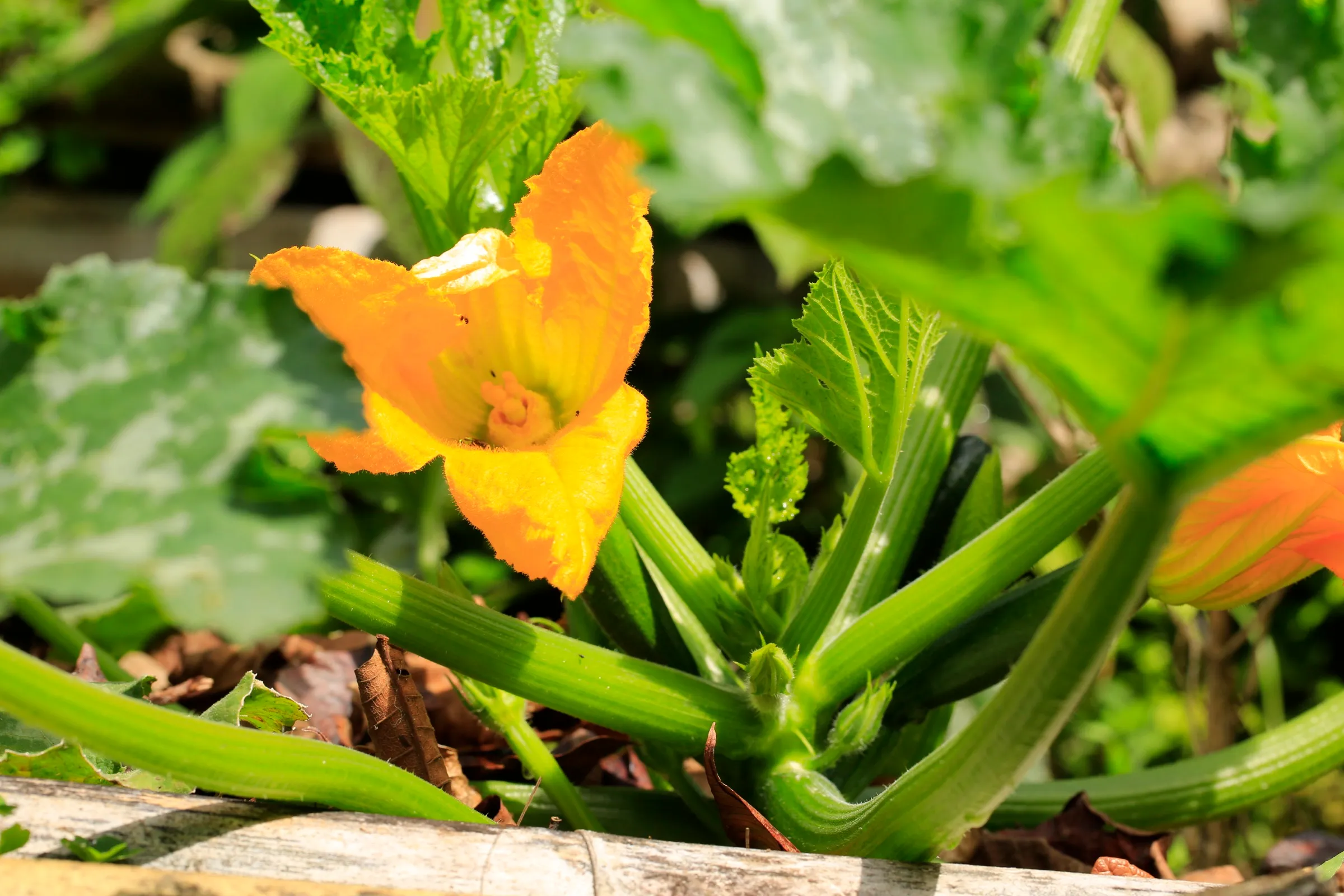
- Pollination can be fickle. Zucchini produces separate male and female flowers on the same plant, and a lack of pollinators can mean small fruits that rot before swelling — hand pollination, with a brush or by rubbing a male flower against a female one early in the morning, easily solves the problem.
- Frequent harvesting, almost daily at the height of the season. The fruits develop extremely fast; picked young (15 to 20 cm), they’re more tender and encourage the plant to keep producing, whereas a fruit left to swell slows overall production.
Zucchini in Our Garden
Zucchini is originally a warm-climate plant that loves full sun and fairly high temperatures to fruit well — a profile that, on paper, doesn’t exactly match the almost constant coolness of the Horqueta cloud forest. In practice, it adapts remarkably well, for two reasons specific to altitude: solar radiation is more intense than in the lowlands, even in cool weather, which more than makes up for lower night temperatures, and the volcanic soils, rich in organic matter, match its hungry appetite exactly. So the real point of vigilance here isn’t a lack of heat but the ambient humidity of the cloud forest, which can encourage powdery mildew more than in a dry climate — generous spacing between plants and well-targeted watering at the base become all the more important.
Good Companions
- Corn and pole beans. The traditional “three sisters” pairing: the corn serves as a stake for the beans, which fix nitrogen in the soil for the benefit of the other two, and the broad zucchini leaves cover the ground, limiting weeds and holding in moisture.
- Nasturtium. A classic trap crop for aphids, which it draws away from the zucchini foliage — and its edible flowers attract pollinators as a bonus.
- Radish. Sown along the edges, it’s thought to help deter the striped cucumber beetle, a pest that readily attacks young cucurbit plants.
- Borage and dill. Two plants that are very effective at attracting bees and other pollinators — a precious asset for a plant whose fruiting depends directly on good pollination.
- Alliums along the edges. Onion and garlic are thought to keep certain pests away with their strong smell, without bothering zucchini, whose root system is shallow and not very competitive.
Plants to Avoid
- Potato, which shares zucchini’s susceptibility to soil-borne fungal diseases and competes directly for nutrients — two hungry plants exhaust each other if they’re too close.
- Other cucurbits planted too tightly (cucumber, melon, other squashes) — not because of cross-pollination risk, which has no effect on the taste of that year’s fruit, but because they share the same pests and diseases, and concentrating them raises the risk of a widespread infestation.
- Fennel, reputed to be mildly allelopathic — it’s said to release compounds that inhibit the growth of several neighboring vegetables, zucchini included — although how strong this effect really is remains debated among organic gardeners.
Good to Know
- Botanically speaking, zucchini is a fruit — it develops from the fertilized flower and contains seeds — even though it’s cooked and classified as a vegetable in everyday life.
- It comes from the Americas, not the Mediterranean. Cucurbita pepo was already being grown in Mesoamerica several thousand years ago; it was Italian growers around Milan who, in the 19th century, selected the elongated form and immature harvest we associate with modern zucchini today.
- Each female flower gives one fruit, but every plant produces dozens. That continuous production, spread over several months, explains zucchini’s (sometimes dreaded) reputation for taking over the garden and the kitchen at the height of the season.
- Male and female flowers are easy to tell apart. The female flower has a small swelling at its base — the future fruit — which the male flower, borne on a long, thin stalk, lacks: a useful detail for anyone pollinating by hand.
This article is © Wild on the Farm, Boquete Cloud Forest Lodge. All rights reserved — it may not be reproduced, republished, or redistributed without prior written permission. Read our full legal notice →