Nutritional Properties & Benefits
The blackberry is the fruit of brambles, shrubs of the genus Rubus, in the rose family — along with raspberries, strawberries, and roses. It’s one of the fruits richest in fiber: a good handful provides as much as a slice of wholemeal bread, for very little sugar and very few calories. It’s also a good source of vitamin C, vitamin K, and manganese. Its almost black color comes from anthocyanins, antioxidant pigments it contains in large amounts, together with ellagic acid; these compounds are studied for their effects on cardiovascular health and cell aging, without that amounting to any therapeutic promise. Bramble leaves, rich in tannins, are traditionally used as a tea or gargle for sore throats. Few cautions, except that its many small seeds can bother sensitive digestions, and that fruit picked close to the ground is always better rinsed.
This information is for educational purposes only and reflects traditional and commonly documented uses of this plant. It is not medical advice and does not replace the guidance of a qualified healthcare professional. Always consult your doctor before using any plant medicinally, especially if pregnant, nursing, or taking medication.
How to Eat It
The blackberry is eaten first of all as it is, warm from the sun, picked by hand. Since it stops ripening once picked, it has to be taken at the right moment: entirely black, slightly matte, and coming away without resistance. In the kitchen it makes deep purple jams and jellies, coulis, sorbets, pies, and crumbles, on its own or with apple. In Latin America, mora is mostly drunk as juice or as a batido, blended with water or milk and then strained to remove the seeds. On the savory side, a blackberry sauce sharpened with a dash of vinegar goes very well with duck, pork, and strong cheeses. It’s a fragile fruit: it keeps for a day or two in the cool, unwashed until the last moment, and freezes very well, spread on a tray before being bagged.
How to Grow It Organically
The bramble is a vigorous plant, almost too vigorous: the whole art lies in training it rather than in getting it to grow.
- A perennial crown, two-year canes. Each cane grows in its first year, fruits in its second, then dies; the crown itself lives for many years.
- Prune after harvest. Cut the canes that have fruited at the base and keep the young canes of the year, which will fruit in their turn.
- Train it. Fanned out on wires or a fence, the canes stay airy, the fruit stays clean, and picking becomes easy.
- Sun and cool soil. Humus-rich, slightly acid earth under a thick mulch; brambles tolerate part shade but fruit better in sun.
- Propagate by tip layering. The tip of a cane laid on the ground roots by itself in a few weeks — which is also how it takes over a plot if left to its own devices.
- Contain the suckers. Pull out the shoots that come up outside the row.
- Air against rot. In a humid climate, gray mold threatens crowded fruit; airy training and frequent picking are the best prevention.
- Share with the birds, or put up a net at harvest time.
Blackberry in Our Garden
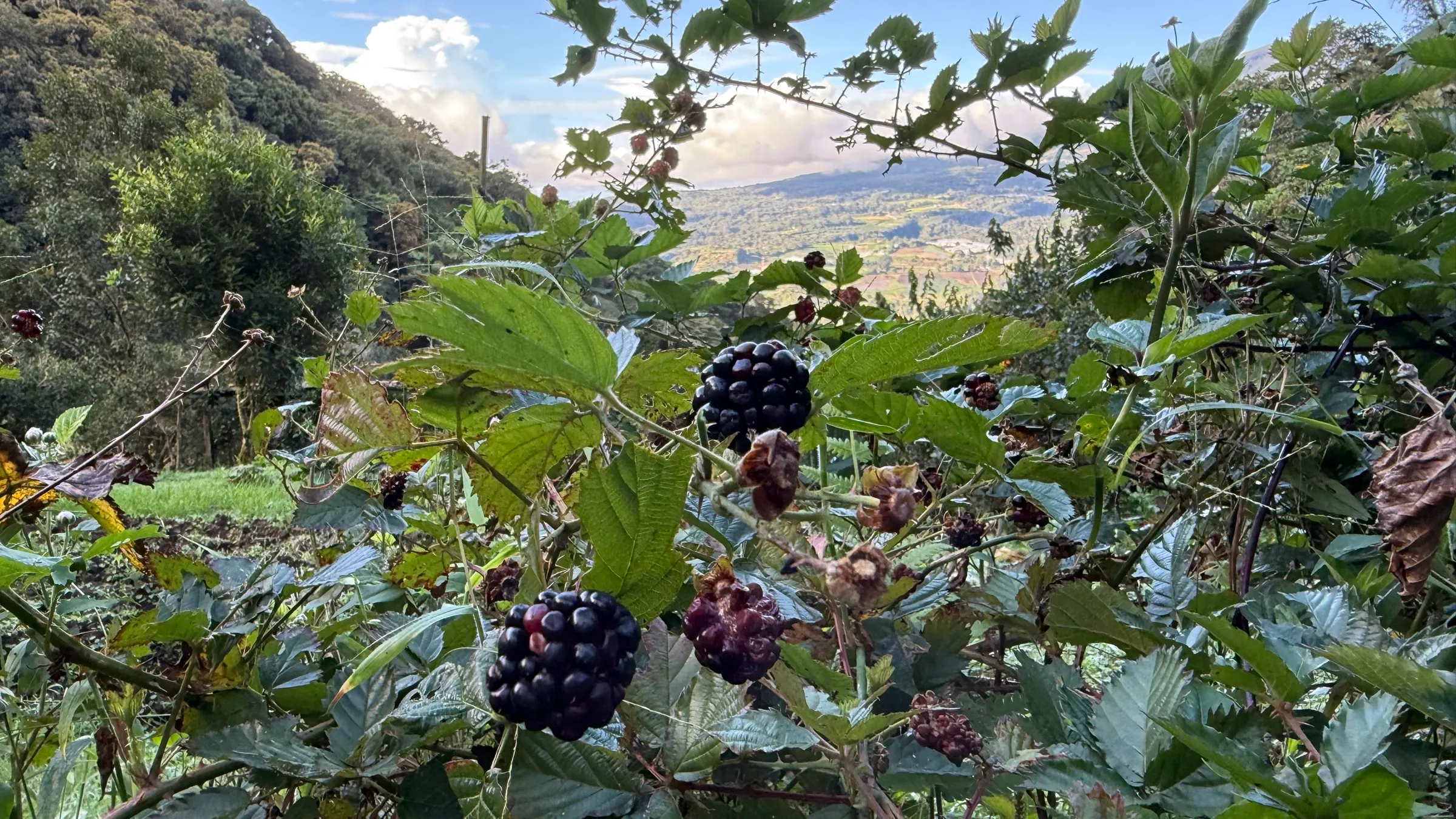
Brambles are at home in tropical mountains: several species of blackberry are native to the Andes and Central America, where they grow between 1,500 and 3,000 meters, in cool, humid climates like Horqueta’s. Mora is in fact one of the fruits traditionally grown in the highlands of Chiriquí. With no real winter, our brambles flower and fruit in waves for a good part of the year, and you’ll often see flowers, red fruit, and black fruit on the same cane. The ones in the photo grow on the slope, facing the valley. Our work is mostly pruning and tying in, to keep air between the canes during the rainy season — and picking before the birds do.
Good Companions
- Garlic, chives, and tansy. Their scent is said to keep certain insects away.
- Borage, phacelia, and other nectar-rich flowers. They bring in bees, essential for well-formed fruit.
- Clover and legumes as groundcover. They feed the soil with nitrogen and keep it covered.
- Mint and lemon balm at its foot, enjoying the coolness and part shade.
Plants to Avoid
- Raspberries right next to it. The two share viruses and diseases, which pass easily from one to the other.
- Nightshades (tomato, potato, eggplant). They can leave a disease in the soil, verticillium wilt, to which brambles are susceptible.
- Delicate crops you don’t want overrun. Brambles sucker and layer themselves: better to give them an edge or a fence line.
Good to Know
- It isn’t a berry. Botanically, the blackberry is an aggregate fruit: each little bead is a miniature stone fruit.
- Bramble or mulberry? In French and Spanish, the same word (mûre, mora) covers both the fruit of the bramble and that of the mulberry, a tree that is no relation at all.
- How to tell it from a raspberry. A raspberry comes away leaving its core on the cane and stays hollow; a blackberry keeps its core.
- There are thornless varieties. They make pruning and picking much easier.
- Its flowers are precious to bees. The bramble is one of the great nectar plants of hedgerows.
This article is © Wild on the Farm, Boquete Cloud Forest Lodge. All rights reserved — it may not be reproduced, republished, or redistributed without prior written permission. Read our full legal notice →