Properties & Benefits
Calendula (Calendula officinalis), also called pot marigold, is a member of the daisy family native to the Mediterranean basin, and one of Europe’s oldest skin-care plants. Its flowers owe their color to carotenoids and contain flavonoids and triterpenes — notably faradiol esters — to which its soothing and anti-inflammatory properties are attributed. Its traditional use is well established: in Europe, calendula preparations are recognized as a traditional remedy for minor skin inflammation and to help minor wounds heal. A few clinical studies point the same way, for example on skin irritation caused by radiotherapy, but they remain few in number.
On the farm, we’ve had direct experience of it. We make skin-care products with our flowers, and we have seen on ourselves, on serious burns, a beneficial effect we don’t hesitate to call extraordinary. That is a testimony, not a promise: a serious burn should be shown to a doctor first, with calendula as a complement. Two cautions: people allergic to the daisy family (ragweed, chamomile, arnica) may react to calendula, and taking it internally is not recommended during pregnancy.
This information is for educational purposes only and reflects traditional and commonly documented uses of this plant. It is not medical advice and does not replace the guidance of a qualified healthcare professional. Always consult your doctor before using any plant medicinally, especially if pregnant, nursing, or taking medication.
How to Use It
For the skin. The basic preparation is an infused oil: fill a jar with thoroughly dried flowers — this is essential, since fresh flowers would make the oil go moldy — cover with olive or sunflower oil, leave to steep for three to four weeks away from the light, stirring now and then, and strain. This golden oil is used as it is on dry, irritated, or overheated skin, or turned into a balm by melting it gently with a little beeswax.
In the kitchen. The petals are edible, with a slightly peppery, faintly bitter flavor. Scatter them over salads, rice, omelets, and soups, or work them into butter or fresh cheese. It was once called “poor man’s saffron”: the petals color dishes yellow, without having the fragrance. Only the petals are eaten, not the green heart of the flower, which is more bitter.
As a tea. A few dried flowers in a cup of just-boiled water give a mild infusion, which tradition also uses cooled, as a compress or a mouth rinse.
How to Grow It Organically
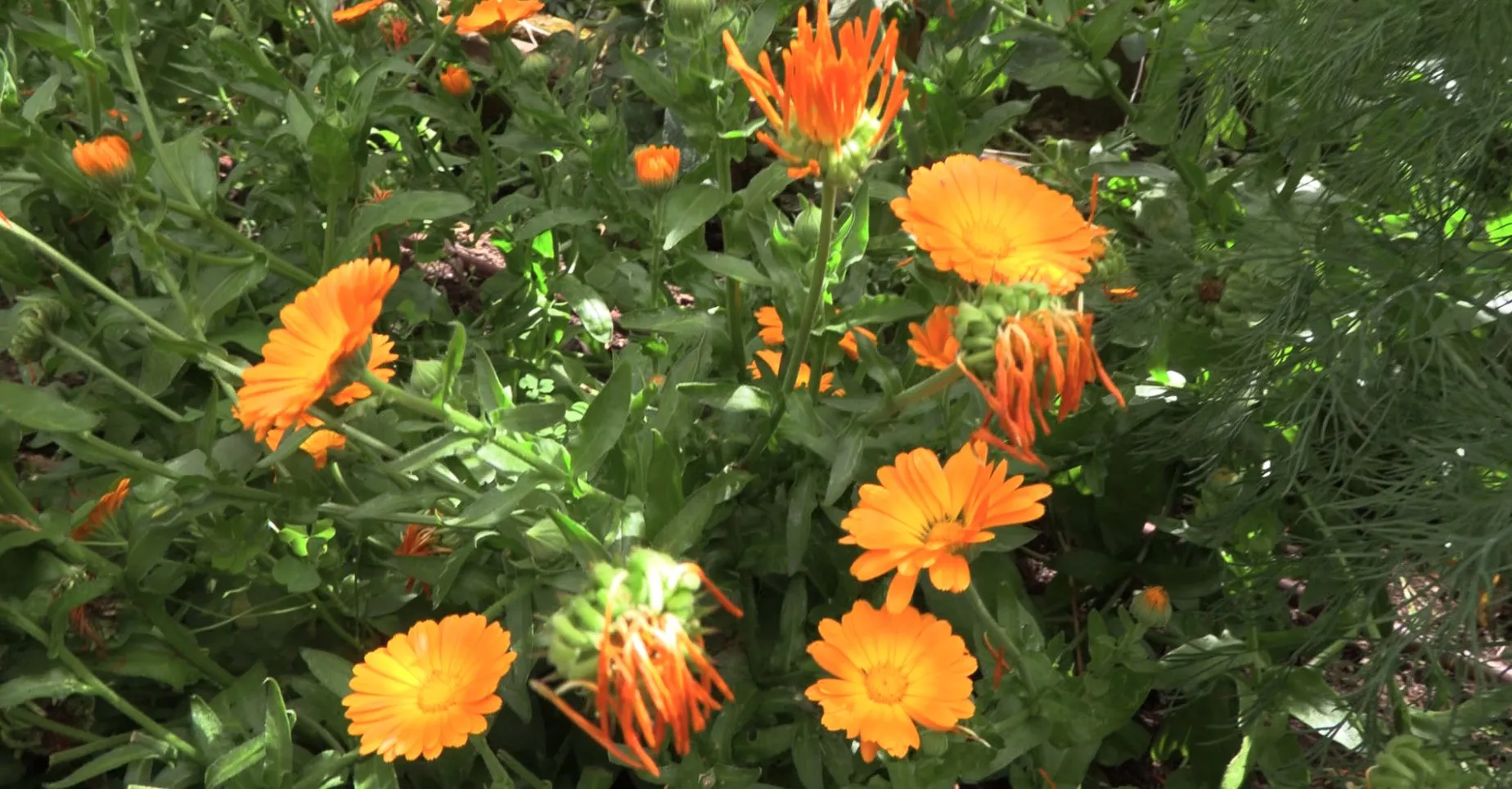
It’s one of the easiest flowers in the garden: it grows fast, blooms for a long time, and reseeds itself.
- Sow directly in place. The seeds, large and curved like little claws, go in a centimeter deep and come up in one to two weeks.
- Sun or light part shade. Calendula prefers coolness to great heat, which interrupts its flowering.
- Ordinary soil. Earth that is too rich gives plenty of leaves and fewer flowers.
- Twenty-five to thirty centimeters between plants.
- Pick, and pick again. The more you harvest the flowers, the more the plant produces; pick in the morning, once the dew has dried, when the flowers are fully open.
- Dry in the shade. Spread the flowers in a single layer, somewhere airy, until they’re brittle — a delicate step in a humid climate.
- Watch for powdery mildew in the rainy season; pull out tired plants and let the young self-sown seedlings take over.
Calendula in Our Garden
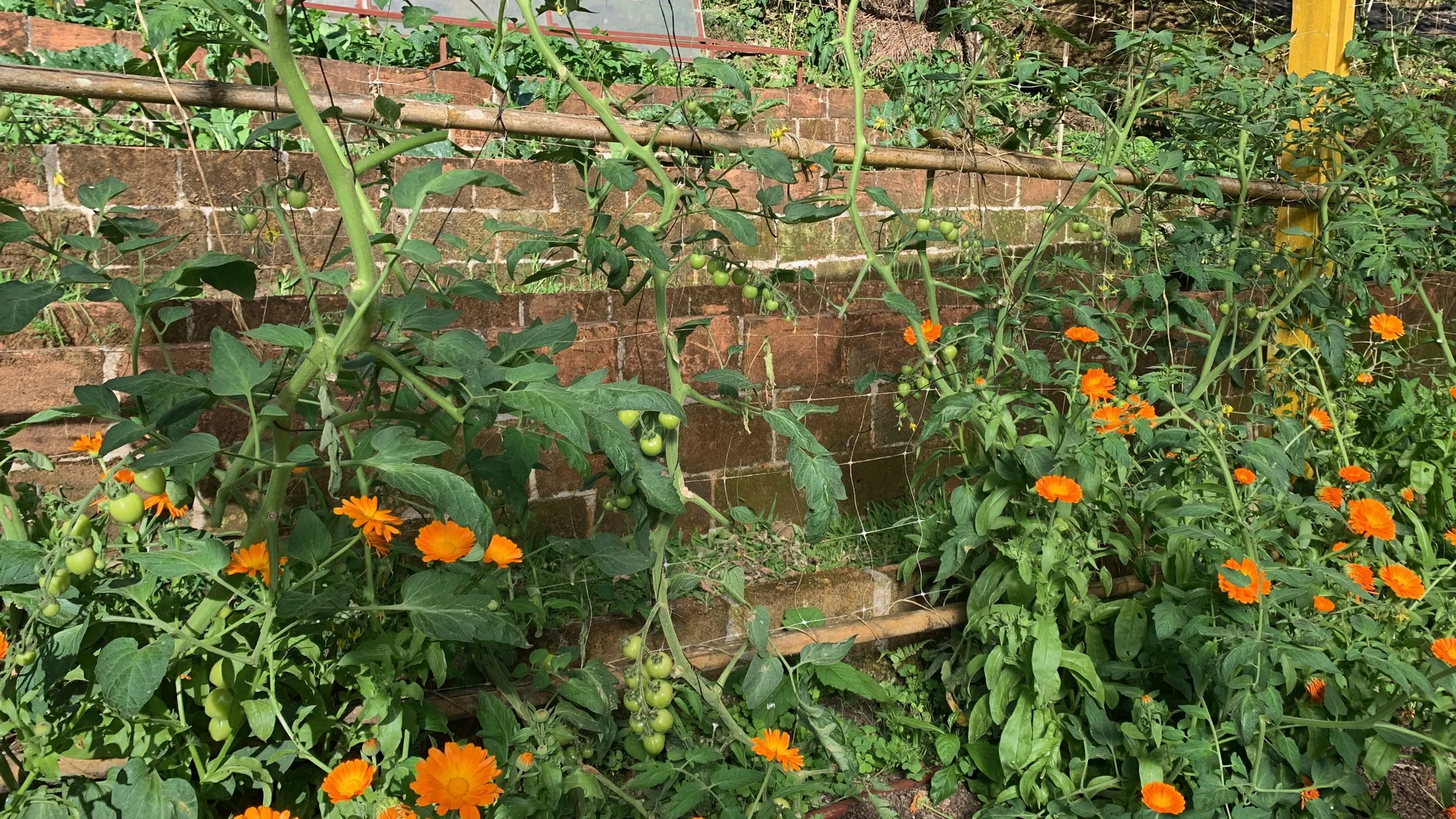
Here, calendula doesn’t live in a flower bed of its own: it grows in among the vegetables. In the photo it’s flowering at the foot of the tomatoes, on a garden terrace, and you’ll find it between the beds more or less everywhere. We use it as an insect repellent: its strong scent and sticky stems keep away or trap a share of the pests, while its flowers attract hoverflies and ladybugs, great eaters of aphids. In a garden grown with no treatments at all, that’s precious protection. The coolness of Horqueta, at 1,800 meters, suits it perfectly: it flowers almost all year, and we pick the blooms regularly to dry them and make our oils and balms.
Good Companions
- Tomatoes. This is the pairing we use: calendula flowers at their feet and helps protect them.
- Cabbages, beans, and zucchini. It attracts the beneficial insects that keep aphids and caterpillars in check.
- Lettuces and carrots. It edges the beds without shading them.
- Other useful flowers (borage, nasturtium, snapdragon). Together they feed pollinators and beneficial insects all year.
Plants to Avoid
- Very few plants mind it. It’s one of the most tolerant companions in the vegetable garden.
- Fragile young seedlings. It reseeds abundantly and can smother them if it isn’t thinned.
- Waterlogged, airless corners, where powdery mildew quickly sets in.
Good to Know
- Its name comes from the calendar. Calendula comes from the “calends,” the first day of the month for the Romans: in a mild climate, it flowers practically every month.
- It follows the sun. Its French name, souci, comes from the Latin solsequia, “sun-follower”: its flowers open in the morning and close in the evening.
- It forecasts rain. According to an old gardener’s saying, flowers still closed by mid-morning mean a rainy day ahead.
- Not to be confused with French marigolds. English calls both “marigold,” but French and African marigolds (Tagetes) are different plants, from Mexico.
- It was long fed to hens. Dried petals were used to give egg yolks and butter a more golden color.
This article is © Wild on the Farm, Boquete Cloud Forest Lodge. All rights reserved — it may not be reproduced, republished, or redistributed without prior written permission. Read our full legal notice →