Nutritional Properties & Benefits
Cauliflower (Brassica oleracea var. botrytis) is a direct cousin of cabbage, broccoli, and kale: all of them are the same species, shaped by centuries of selection. What we eat is a still-immature flower head — thousands of flower buds packed into a compact “curd.” Very low in calories, it’s rich in vitamin C (a raw serving covers a good share of daily needs), and also provides vitamin K, folate (vitamin B9), potassium, and fiber. Like all brassicas, it contains glucosinolates, sulfur compounds that turn, when cut and chewed, into molecules such as sulforaphane, studied for their antioxidant properties — interesting research, but it doesn’t make a vegetable into a medicine. It’s also a good source of choline, a nutrient that supports brain and liver function. Two cautions: its fermentable fiber can cause bloating in sensitive people, and anyone taking vitamin K–antagonist blood thinners should keep their intake steady rather than highly variable.
This information is for educational purposes only and reflects traditional and commonly documented uses of this plant. It is not medical advice and does not replace the guidance of a qualified healthcare professional. Always consult your doctor before using any plant medicinally, especially if pregnant, nursing, or taking medication.
How to Eat It
Cauliflower is far more interesting than its reputation once you stop boiling it for too long. Roasted in the oven, whole or in florets, with olive oil and spices, it caramelizes and takes on a nutty flavor; cut into thick slices and seared in a pan, it becomes a vegetable “steak.” Raw and finely grated, it makes a tabbouleh or a crunchy couscous; cooked and blended, it gives a wonderfully smooth velouté or a light purée. You’ll find it in the béchamel gratin of French cooking, in Indian aloo gobi with potatoes and turmeric, and in pickles and Italian giardiniera. The tender leaves and the core are edible too — sautéed, roasted, or added to soups — and it would be a shame to throw them away. Brief cooking, by steaming or roasting, better preserves the vitamin C and limits the sulfur smell, which appears mostly when cooking drags on. It keeps for about a week in the refrigerator, stored head-down so moisture doesn’t collect in the curd.
How to Grow It Organically
Cauliflower is the most demanding member of the cabbage family: it wants steady growth, without a check, from sowing to harvest.
- Sow in a nursery. The seeds come up in under a week; transplant the seedlings at four to five true leaves, burying the stem up to the first leaves.
- Rich, deep, cool soil. It’s a hungry vegetable: a good helping of mature compost at planting, then a thick mulch to hold moisture.
- Regular watering. A dry spell or a pause in growth gives tiny, premature heads, or plants that bolt to seed.
- Space. Fifty to sixty centimeters between plants: the big leaves need room to feed the head.
- Blanch the head. When it reaches the size of an egg, fold or snap a few leaves over it to protect it from the sun: it stays white and tender instead of yellowing.
- Harvest on time. Cut the head when it’s firm and tight, before the florets start to separate.
- Against caterpillars and aphids, check the undersides of the leaves, pick by hand, use insect netting if needed, and keep a rotation of at least three years between two brassica crops to avoid clubroot.
Cauliflower in Our Garden
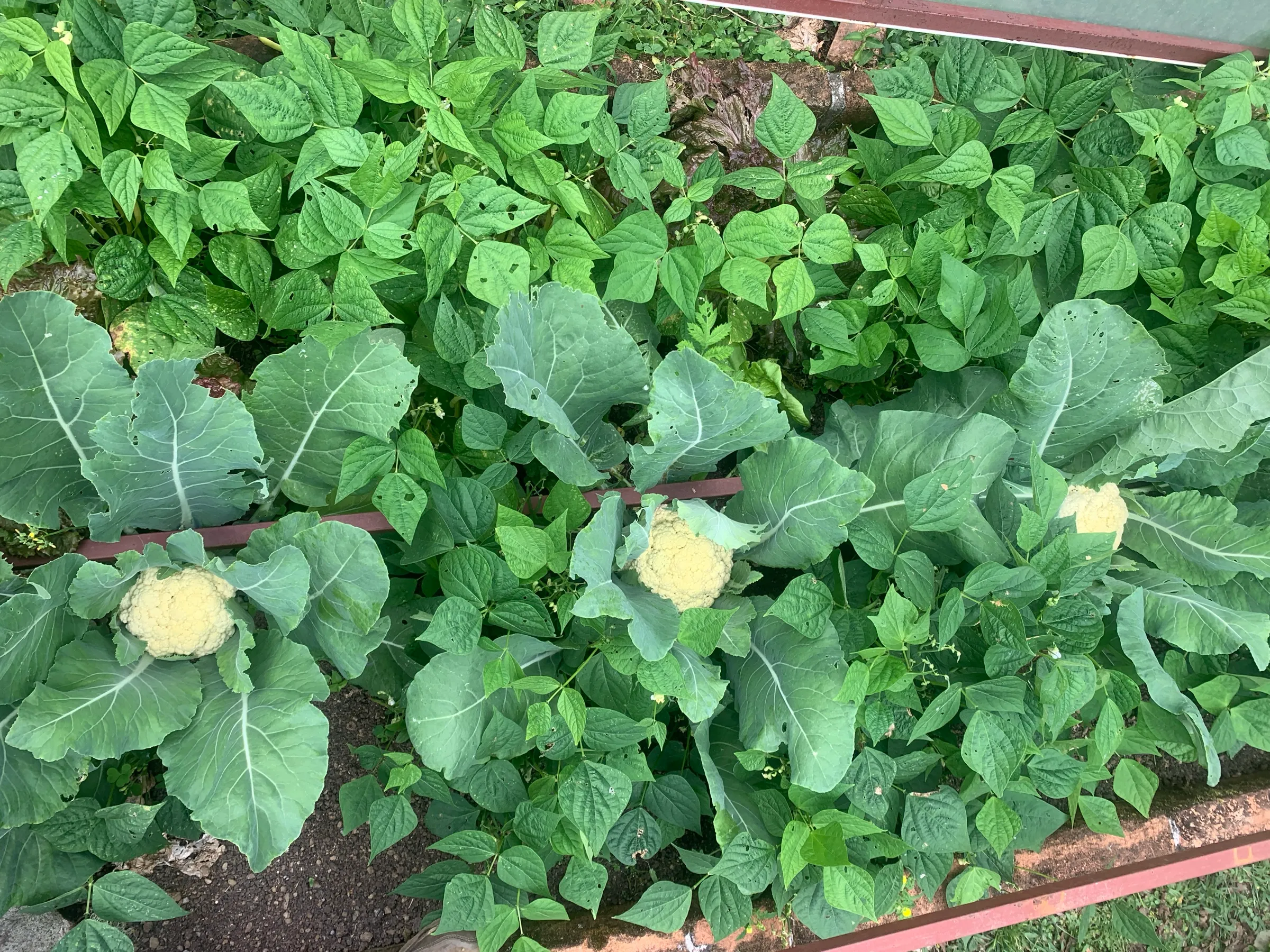
Cauliflower is a cool-climate vegetable: above 25 °C (77 °F), the head forms poorly. At 1,800 meters, the cloud forest of Horqueta gives it, all year round, the mild temperatures it finds elsewhere only in spring and autumn, and plantings can be staggered through the months. Our real difficulty is too much water in the rainy season: we grow it in raised, well-drained beds, and we keep an eye on slugs and caterpillars, which enjoy the humidity as much as it does. In our beds it grows among the beans — in the photo you can see the cream heads emerging between the big blue-green leaves and the bean foliage. The beans cover the soil, keep it cool and, like all legumes, enrich the earth with nitrogen, which cauliflower consumes in quantity.
Good Companions
- Beans and peas. They fix nitrogen from the air and cover the soil between the plants — this is the pairing we use in the garden.
- Celery. Its scent is said to keep the cabbage white butterfly away.
- Aromatic herbs (sage, thyme, rosemary, mint). Their fragrance confuses insect pests.
- Nasturtium and marigold. Nasturtium draws aphids away from the brassicas; marigold attracts beneficial insects.
- Lettuce and spinach. Harvested before the cauliflower fills its space, they make use of the open ground between young plants.
Plants to Avoid
- Other brassicas right next to it year after year. They share the same diseases and pests; better to rotate them around the garden.
- Strawberries. An old garden tradition advises against pairing them.
- Tomatoes. Two very hungry crops competing for the same nutrients.
- Fennel, for its general allelopathic effect.
Good to Know
- Its name means “cabbage flower.” From the Latin caulis (cabbage) and floris (flower) — we really do eat a flower, picked before it opens.
- It comes in several colors. Orange (rich in beta-carotene), purple (rich in anthocyanins), or green; Romanesco, with its spirals, is a close relative famous for its fractal geometry.
- Mark Twain had a line about it. He described cauliflower as a cabbage “with a college education.”
- It travelled from the eastern Mediterranean to Europe. Long grown in the Near East and Cyprus, it reached Italy and then France during the Renaissance, where it became a vegetable of Louis XIV’s table.
- The leaves are edible. Roasted in the oven with a little oil, they turn as crisp as kale chips.
This article is © Wild on the Farm, Boquete Cloud Forest Lodge. All rights reserved — it may not be reproduced, republished, or redistributed without prior written permission. Read our full legal notice →