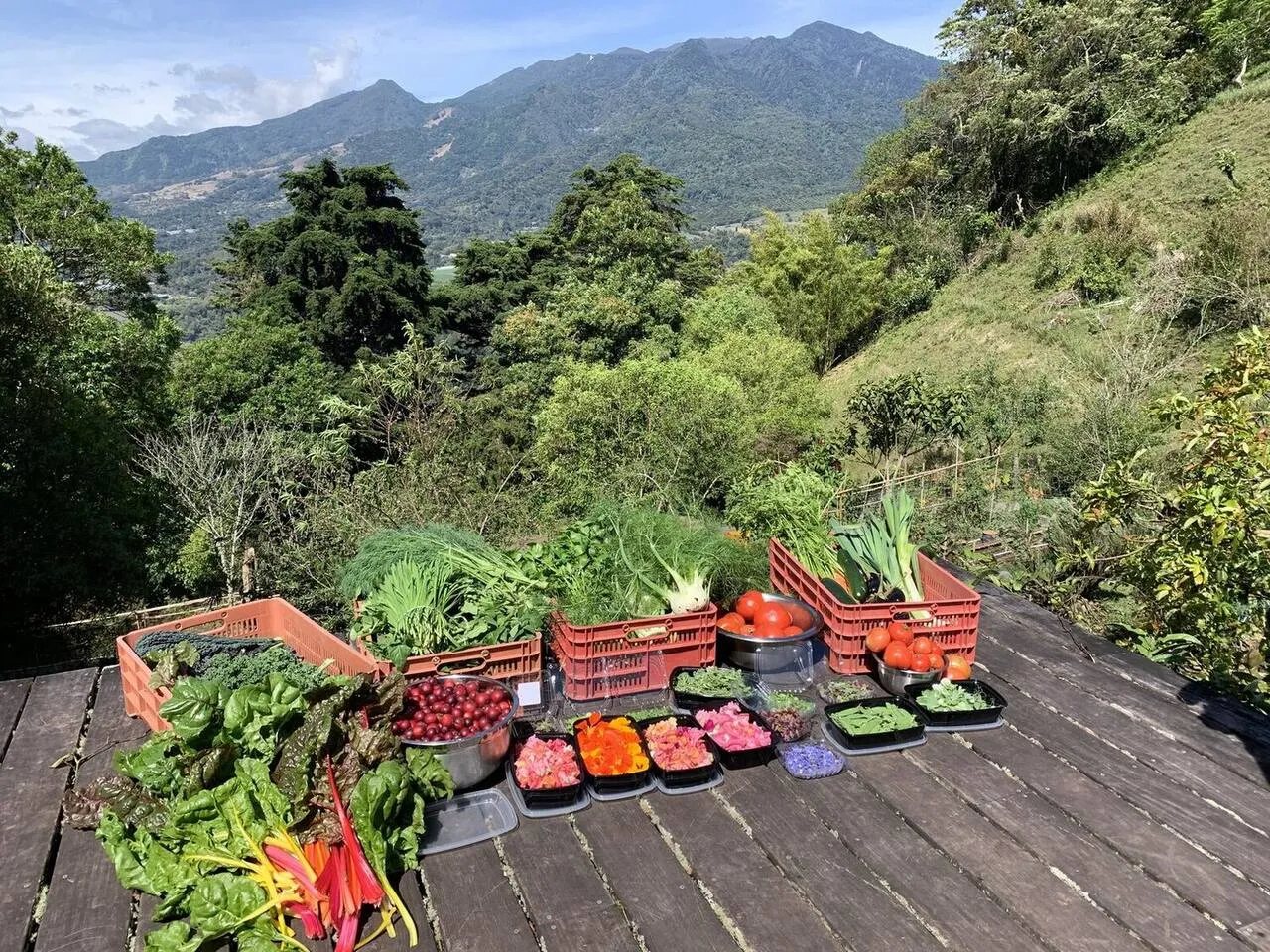
A Land That Already Knew
Here, the soil has a head start. Every terrace on the slopes of the Barú still carries the memory of its old lava flows — a dark, dense, mineral-rich volcanic earth, replenished free of charge by a volcano that has slept for more than fifteen centuries. Add to that the altitude — between 1,000 and 2,000 meters depending on the finca — and the cool, humid air of the cloud forest, which naturally discourages the insects and fungi that plague crops in the tropical lowlands, and it becomes clear why growing without pesticides is less a gamble here than a given. Boquete didn’t become organic country out of activism. It already was, long before anyone needed to put that on a label.
Two Certifications, Two Eras
Which raises a more legal question: since when has the word “organic” actually meant something in Panama, legally speaking? Two paths exist, and each tells a different story. The first runs through Bio Latina, a private certification body founded in 1998, accredited under the international ISO 17065 standard and recognized by both the European Union and the United States. By the turn of the 2000s, it was already one of the few certifiers of its kind present in the country — built for export, designed for markets that demand paperwork. Bio Latina today certifies more than 400 operators across Latin America, covering more than 50,000 producers.
The second path is far more recent, and entirely Panamanian. Since 2017, the country has issued its own national seal, Panamá Orgánico, through ACERT — the Control and Certification Authority under the National Directorate of Plant Health at MIDA — under the legal framework of Law 8 of 2002 and its 2015 implementing decree. Where Bio Latina looks abroad, Panamá Orgánico looks inward: a recognition designed for the domestic market, for producers who sell first to their neighbors rather than for export.
The result: Panama today counts more than 7,000 hectares under organic cultivation and roughly a thousand certified producers, across both certifications combined — concentrated mainly in the provinces of Chiriquí, Herrera, Veraguas, and Bocas del Toro. On that map, Boquete stands out: one of the country’s most active regions, and, as it turns out, one of its oldest.
From Finca de la Amistad Verde to a Permaculture Macadamia Farm
Our permaculture and organic garden: what we grow, and what it’s good for →
That age has a name. High above Boquete, a property known today as Wild on the Farm once went by another identity: Finca de la Amistad Verde, founded in 2008. It was under that name that it became, in 2010, the very first vegetable farm in Panama certified organic by Bio Latina — a distinction no other vegetable operation in the country could claim at the time.
The farm supplied El Mercadito Biológico, an organic grocery-restaurant in the San Francisco neighborhood of Panama City — a concept then unheard of in the capital, blending a fine grocer, a restaurant, a juice bar, and a bakery, entirely organic. El Mercadito Biológico guaranteed its customers the origin and quality of its produce by sourcing it directly from the Finca de la Amistad Verde, in Boquete — a partnership between the valley and the capital, at a time when the word “organic” was still looking for an audience in Panama.
It was also during this period that Pascal, the Frenchman behind the Finca de la Amistad Verde, began volunteering his time to train other farmers in the region in organic methods — an effort that led to the founding of a local association of organic producers. Two decades on, most of those pioneers have grown old, without much of a next generation stepping in to carry the work forward — a quiet reminder that organic farming in Boquete owes a great deal to a handful of people who did the work without ever looking to make a show of it.
Eighteen years of experimentation on that same soil, first in vegetables and fruit, eventually turned toward macadamia — to the point that the property, still a working farm today, now run under permaculture principles under the name Wild on the Farm, where it also welcomes visitors, is the only macadamia farm in Panama operating on these principles. Rather than reach for industrial fertilizers, it produces its own organic fertilizers from the fermentation of plants grown on-site specifically for that purpose — a direct extension of the know-how built on the Finca de la Amistad Verde’s vegetable fields.
Coffee: Between Tradition and Gentle Farming
Coffee is no exception to this chemical-free culture either. In El Salto, above the town, Finca Dos Jefes — bought as an abandoned plot in 2003 by Americans Rich Lipner and Dee Harris — has brought seven acres of shade-grown Arabica back to life (Geisha, Caturra, Catuai, Criollo), planted and harvested on the rhythm of the moon’s phases. Their Café de la Luna is sun-dried slowly, with no chemical inputs whatsoever — an artisanal method meant to preserve the quality of the bean as much as the health of the soil and the hands that pick it.
More broadly, the region benefits from the international Bird Friendly certification, created by the Smithsonian in 1996, which requires 100% organic coffee grown under native tree cover — a way of protecting both the forest and the migratory birds that winter in Chiriquí’s shade-grown coffee farms.
Organic Vegetable Farming: From the Tuesday Market to the Greenhouses of Alto Quiel
The weekly market remains the truest barometer of this industry here. Every Tuesday, Finca Santa Marta holds a permanent stall at the Boquete market — and on Fridays, at Restaurante Maná in Volcán — loaded with vegetables, tropical fruit, and culinary and medicinal herbs, all grown without chemicals.
In the hamlet of Alto Quiel, several growers farm organic hydroponics — microgreens, aromatic herbs, chard, radishes, carrots — supplying a share of the area’s restaurants and markets. And the association La Vida Orgánica has spent years promoting hydroponics, aeroponics, aquaponics, and permaculture in Boquete, with an openly stated ambition to make the valley Central America’s leading agrotourism destination.
Piero and His Goats, in Palmira Abajo
About twenty minutes from Boquete, on the road to Palmira Abajo, Piero Mercanti and his wife, Adriane Cromer, raise goats at Milky Way Farms. Their farm was born of a simple concern: avoiding the pharmaceutical and agrochemical residues found in industrially produced dairy. The farm isn’t certified organic — but in spirit and in practice, it follows the same principles as the region’s certified farms. Visitors can meet the goats, then round off the visit with a tasting of cheeses made right there on-site.
Cecilia and Tomas, Twenty Years of Soil and Friendship
At the Tuesday market in Boquete, there’s a stall that never tries to draw attention to itself: that of Cecilia and Tomas. No logo, no framed certificate, no pitch — just vegetables grown without chemicals, week after week, for longer than most of the customers who stop at their table would ever guess.
Tomas’s story in Boquete begins in 2008, alongside a French friend, Pascal, with whom he laid the first stones of what would become the Finca de la Amistad Verde — the same land that, years later, would become Wild on the Farm. Together, Pascal and Tomas experimented with and introduced to Panama vegetable varieties that were, at the time, unknown in the country — a good share of what you’ll find today on the region’s organic stalls owes its original seed, directly or indirectly, to the two of them. To this day, Tomas and Cecilia farm right next door, neighbors to that shared history, bound by twenty years of friendship and by a common conviction: that organic isn’t first a label, but a way of living with the land.
What stands out about Cecilia and Tomas is precisely this lack of staging. No certificate on display, no marketing, no story to sell — just a practice held with consistency, refined year after year by experience rather than by a checklist. In a valley where the word “organic” is only just starting to become a tourism pitch, it’s figures like them — who have stayed almost invisible — who laid its most sincere foundations: Boquete’s real organic researchers, without ever having tried to be.
A Still-Quiet, but Very Real, Movement
Unlike coffee, whose international reputation already draws crowds, organic farming in Boquete remains largely a matter of short supply chains: weekly markets, direct farm sales, small partnerships with the valley’s restaurants and hotels. It’s a story that begins well before organized tourism arrived — the Finca de la Amistad Verde certified as early as 2010, long before “organic” became a common selling point in Panama — and one that continues today at the same modest scale: a handful of farms that know each other, recommend each other, and meet up, week after week, at the same market stalls.
This article is © Wild on the Farm, Boquete Cloud Forest Lodge. All rights reserved — it may not be reproduced, republished, or redistributed without prior written permission. Read our full legal notice →