Nutritional Properties & Benefits
The snow pea, or mangetout (Pisum sativum var. saccharatum), is a pea harvested before the seeds swell, and eaten pod and all. What sets it apart from the shelling pea is the absence of “parchment,” the fibrous membrane that makes ordinary pods inedible. Because the pod is eaten, it’s closer to a green vegetable than to a pulse: very low in calories, it’s rich in vitamin C — a serving covers a good share of the day’s needs — in vitamin K, provitamin A, and folate, and provides fiber, iron, and a little plant protein. Cautions are few: its fiber and fermentable sugars can cause bloating in sensitive people, and anyone taking vitamin K–antagonist blood thinners should simply keep their intake steady.
This information is for educational purposes only and reflects traditional and commonly documented uses of this plant. It is not medical advice and does not replace the guidance of a qualified healthcare professional. Always consult your doctor before using any plant medicinally, especially if pregnant, nursing, or taking medication.
How to Eat It
All the charm of the snow pea lies in its crunch and its sugary sweetness, which overcooking destroys. Start by topping and tailing it, pulling away the string that runs along the pod. After that, two minutes is enough: stir-fried in a wok over high heat with garlic and ginger, Chinese style, or blanched for a minute and then refreshed in cold water to keep its bright green. It’s also eaten raw, whole or sliced, in salads and as a nibble. It goes with fish, fried rice, noodles, and curries, and pairs very well with mint, sesame, lemon, and butter. The plant’s young shoots and tendrils, tender and pea-flavored, are a prized vegetable in Asian cooking, and the flowers are edible. Once picked, it loses its sugar quickly: better to eat it within two or three days.
How to Grow It Organically
It’s a cool-climate crop, simple and generous, provided you give it something to climb.
- Sow directly in place. One seed every five centimeters, three centimeters deep; it comes up in one to two weeks.
- Coolness. Peas grow best between 13 and 18 °C (55–65 °F) and suffer above 25 °C (77 °F): the flowers drop and the pods toughen.
- A trellis from the start. Climbing varieties reach 1.5 to 2 meters; netting or wire mesh stretched between posts is enough, and the tendrils grip it by themselves.
- No nitrogen fertilizer. Like all legumes, peas fix nitrogen from the air thanks to the bacteria on their roots; a little mature compost is enough.
- Regular watering, especially during flowering and pod formation, and a mulch at the foot.
- Harvest young and often. Pick the pods while still flat, before the seeds show, every two days: the more you pick, the more the plant produces.
- Leave the roots in the ground at the end of the crop: they return their nitrogen to the soil for whatever follows.
- Watch for powdery mildew, the white felt that appears on the leaves late in the crop; well-spaced plants and a three- to four-year rotation keep it in check.
Snow Peas in Our Garden
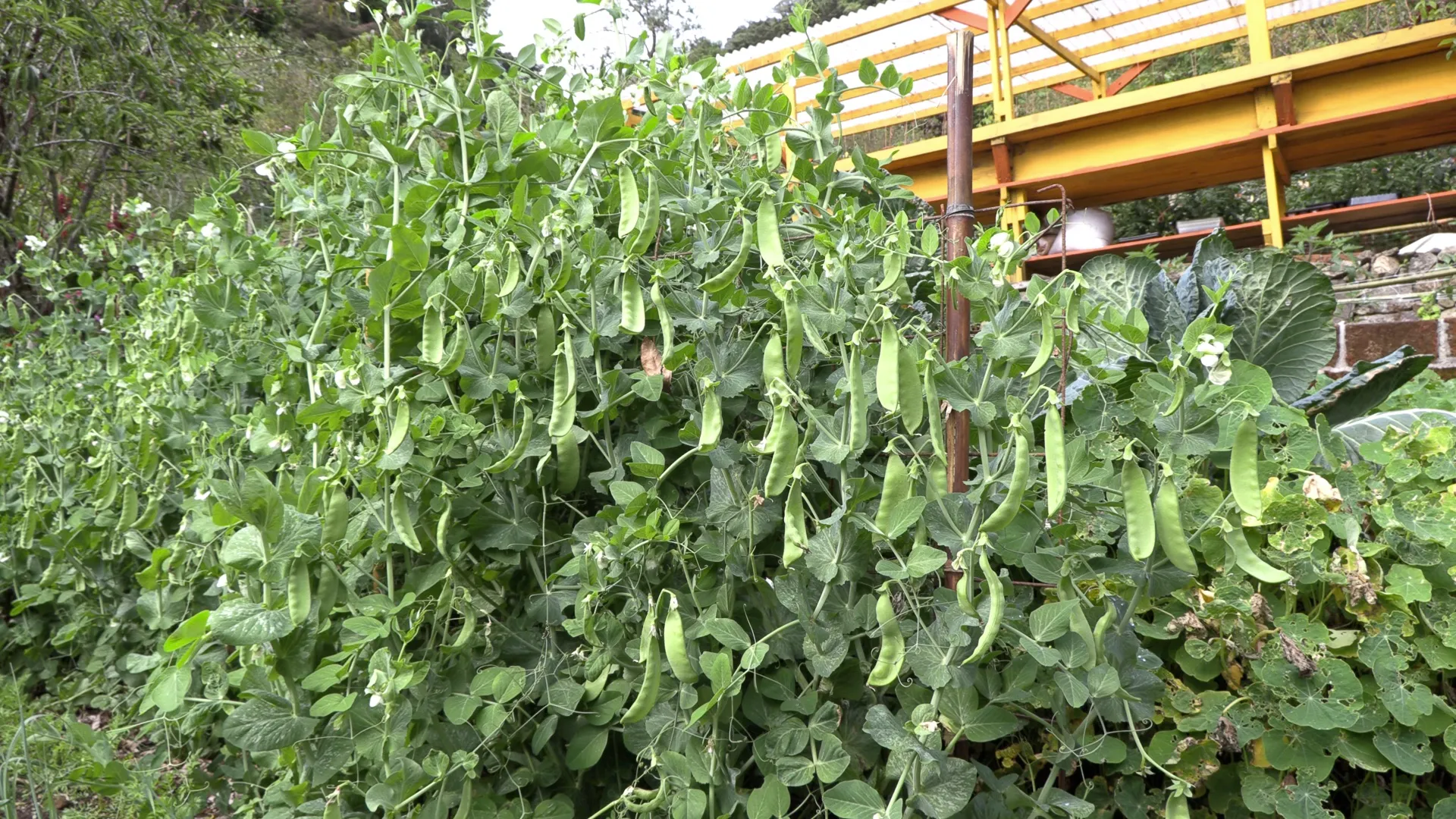
Peas are a spring vegetable in temperate countries, gone as soon as summer arrives. In Horqueta, at 1,800 meters, it’s spring all year: the coolness of the cloud forest suits them perfectly, and we can stagger sowings through the months instead of waiting for a season. The photo shows the result — a real wall of green, nearly two meters high, covered at once in white flowers and pods ready to pick. They climb a net stretched between posts, with cabbages alongside and nasturtiums at their feet. In the rainy season we space the rows wider so that air can move through, since humidity encourages powdery mildew.
Good Companions
- Cabbages. They benefit from the nitrogen peas leave in the soil — the pairing you can see in the photo.
- Carrot, radish, and turnip. Root crops that fill the ground at the foot of the trellis.
- Lettuce and spinach. They enjoy the light shade of the pea row.
- Nasturtium. It covers the soil and draws aphids away from the crop.
- Cucumber and corn, which take over after the peas and make use of the enriched soil.
Plants to Avoid
- Garlic, onion, leek, and chives. It’s the most classic incompatibility in the vegetable garden: alliums are said to hold back the growth of peas.
- Other legumes in the same spot, year after year. They share the same soil diseases; better to rotate them.
- Fennel, for its general allelopathic effect.
Good to Know
- Its French name says it all. Mangetout — “eat it all” — and the British adopted the word as it stands.
- The Chinese call it the “Holland pea.” Yet it’s at the heart of their cooking; the name recalls the Dutch traders said to have introduced it to Asia.
- The sugar snap is its descendant. With its round, fleshy pods, it was born in the 1970s from a cross between a snow pea and a shelling pea.
- Genetics was born from peas. Gregor Mendel discovered the laws of heredity by crossing peas in his monastery garden in the 19th century.
- It’s one of the oldest cultivated plants. Peas have been domesticated in the Near East for about ten thousand years.
- Beware the sweet pea. Despite its name, that ornamental is a different species, and its seeds are toxic.
This article is © Wild on the Farm, Boquete Cloud Forest Lodge. All rights reserved — it may not be reproduced, republished, or redistributed without prior written permission. Read our full legal notice →